Pliny the Elder Quotes
It's [the earth's] shape has the rounded appearance of a perfect sphere. This is shown first of all by the name of 'orb' which is bestowed upon it by the general consent of mankind.... Our eyesight also confirms this belief, because the firmament presents the aspect of a concave hemisphere equidistant in every direction, which would be impossible in the case of any other figure.
Many of the ancient world understood the spherical earth over a thousand years before Galileo was persecuted by the Roman Catholic Church for stating that fact. See {590333} for another ancient view.
Pliny the Elder, 29-79, Roman Scholar, Procurator of Spain, Natural History, 77
Sourced by: Eigen's Political and Historical Quotations

Although most people of old many of the ancient world understood the spherical earth over a thousand years before Galileo was persecuted by the Roman Catholic Church for stating that fact. See {590334} for another ancient view. Note that Strabo talks of seamen who tried to circumnavigate the earth so it was a generally held view of the sophisticated at the time of Christ.

Church doctrine was that the earth was flat. Augustine did not believe the contrary, but this quotation shows that a thousand years before Galileo and Columbus, there were many people who did. . There were ancients who knew about the round earth as well. See {590333} and {590334}.

the position of the rising sun at the vernal equinox Dante, as well as other writers understood the spherical earth 200 years before Galileo and 150 years before Columbus. There were ancients who knew about the round earth as well. See {590333} and {590334}.


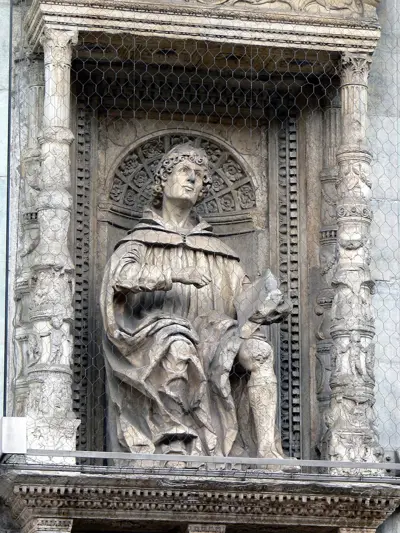
Gaius Plinius Secundus (AD 23/24 – 79), called Pliny the Elder (/ˈplɪni/), was a Roman author, a naturalist and natural philosopher, a naval and army commander of the early Roman Empire, and a friend of emperor Vespasian. He wrote the encyclopedic Naturalis Historia (Natural History), which became an editorial model for encyclopedias. He spent most of his spare time studying, writing, and investigating natural and geographic phenomena in the field.
