Donald Rumsfeld Quotes
It’s less important to have unanimity than it is making the right decisions and doing the right thing, even though at the outset it might be loathsome.
Donald Rumsfeld, U. S. Secretary of Defense (Republican), U. S. Congressman (Republican, IL), White House Chief of Staff, Quoted in Foreign Affairs, January / February 2003
Sourced by: Eigen's Political and Historical Quotations


The enriched nuclear fuel could be used to operationalize a nuclear bomb. Iran had a history of using illegal poison gas in the Iraq-Iran War (Both sides used chemical weapons.) Iran had a history of aiding terrorist organizations. And Iran is the only nation belonging to the UN and sighing its charter in modern history that has threatened to destroy another nation via their President whose threats had not been retracted. Iran also is a Shiite Muslim nation and is at odds with the Sunni Muslim countries of the Middle East and if the Iraqis developed a nuclear bomb, there would be a Middle Eastern nuclear arms race. If Iraq would not cease its development program under pressure from other nations, a military attack was the other option. All were indeed ugly.

The statement is made by a government minister who has broken the law, and harmed innocent people in order achieve when he believed was a greater good.


The card was issued to all American troops in the theater. Similar versions were distributed to troops in Iraq, and other Arab countries.


When whites first came to America, the Iroquois, were the most sophisticated Native Americans. They were actually a confederation of 5 different tribes each of which was composed if many clans. Although fierce warriors, they had agreed not to fight each other and to assist if any were attacked. They developed a strong agricultural base, to go with the fishing and hunting, and their confederation were very aggressive and sophisticated traders taking them far from their upstate New York “capitol.” Their governmental structure was quite sophisticated with an elaborate, formal, system of checks and balances, multi-cameral legislatures that recognized numbers of citizens, power and wealth, and even cultural traditions. They were literate, capitalistic and globalistic in that they wanted to trade with all. They had written laws, and women had a role that was unique in world history in that only women owned property in a matrilineal society. Further, it was only the Clan Mothers who voted for the 50 Sachems (~Senators)—but their selections had to be accepted by the people they represented. Ironically the descendants of the Iroquois who remained in New York became a very successful Native American group. In the 2000 census, the average Indian in New York State earned the same income as the average White with no Indian gambling money.
Whithead’s view which seems intuitively right to most citizens, tends to be the one that the majority espouses but the minority opposes. At the time, the Republicans controlled the White House and there were a number of polarizing issues, where the Republicans could not obtain consensus and then decided. However, then the Democrats gained control of the White House and Congress the next year, it was the Democrats who claimed that they had to decide. The Republicans, now in the majority, argued that significant changes in America should not be made by narrow majorities and major issues should be tabled if there was no substantial majority. That was the position that the Democrats had espoused when they were in the minority.


Henry of Navarre. The Great Council was the first proposed International governing body—a precursor to the EEC, the UN and the League of Nations. Henry's plan included an international army and navy to enforce the decisions. There were 15 nations proposed in the Great Design. Each one had a veto presaging the United Nations Security Council.

The Barbary Pirates had an incredible extortion racket going in the Mediterranean. If nations would pay them an annual sum each year, they would not attack and seize merchant ships of that country and sell the ships and goods while holding the sailors for ransom. See {640845} ,{640846} & {640848}


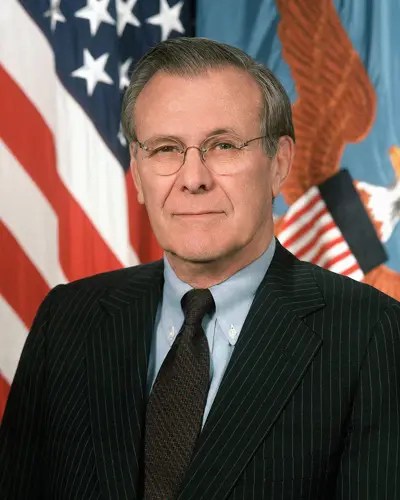
Donald Henry Rumsfeld is a retired American politician. Rumsfeld served as Secretary of Defense from 1975 to 1977 under Gerald Ford, and again from January 2001 to December 2006 under George W. Bush. He is both the youngest and the second-oldest person to have served as Secretary of Defense. Additionally, Rumsfeld was a three-term U.S. Congressman from Illinois (1963–69), director of the Office of Economic Opportunity (1969–70), counsellor to the president (1969–73), the United States Permanent Representative to NATO (1973–74), and White House Chief of Staff (1974–75). Between his terms as Secretary of Defense, he served as the CEO and chairman of several companies.
