Bryan Stevenson Quotes
It saddens me that African Americans - when they express their pain, when they protest about police violence, when they question inequality, when they raise issues of bondage and discrimination - African Americans are seen as not patriotic.
Stevenson, Bryan. Interview by Ezra Klein. The Ezra Klein Show, Vox Media, 2017.

Instead of standing and saluting as professional athletes have done for decades before games, he kneeled and refused to stand. This caused great public criticism but also some initial support. He was potentially risking his multimillion dollar salary as this technically violated his contract to avoid anything embarrassing to the team. He also donated $1 million to programs in the area that were working to enhance Black/white understanding. Even those who disagreed with his choice of protest defended his right to do so, and after the initial furor, public opinion, while not in agreement about his method, tended to support him for having the courage of his convictions and using his celebrity for a worthy cause. After sensing the public opinion, his team matches his $1 donation. Professional athletes both in the NFL and in other sports then began to do the same as a form of protest for the large, disproportionate, number of black men who were killed, mostly when unarmed, by police. The reference to the “paid leave” was the practice followed by most police departments—usually required by collective bargaining agreements with police unions—of placing police officers accused of committing violations of laws or regulations on paid administrative leave while all the investigations, hearings, and other processes . While this practice protected the rights of those police officers who were not guilty, it ended up paying brutal murders for a some time entire their case was decided or acted upon be the district attorney.


Gingrich prefaced his statement with: "It took me a long time and a number of people talking to me through the years to even get a sense of this..."


Black protests and demonstrations were emerging throughout the country after a white police officer shot to death an unarmed black teenager in Ferguson, MO. This argument was made by a number of police apologist whites who could not understand the ferocity and passion of the demonstrations, but Giuliani was the most prominent politician taking that viewpoint. See {642521} for the refutation and response.


This quotation is a wonderful example of Donald Trump's hyperbolic oratory, Must politicians would say that "African communities are in terrible shape." But that would not get much media attention and coverage of his speech. So he ads ""worst". And not content with the dama of "worst" which was clearly untrue, he then added "Ever, Ever, Ever". Which not only makes the statement unture but rediculous in the light of lynchings, race riots, slavery, and other aspects of past African American experience in America. However, that evening, this line was on almost every news television show in America, repeated on radio, and was in the vast majority of newspapers. This lie got him millions of dollars in free publicity. No one had ever been better at manipulating the media that way. See Quotation 664146 for President Obama's comment on Trump's statement. Also, 644399 for the assessment of the NAACP President.


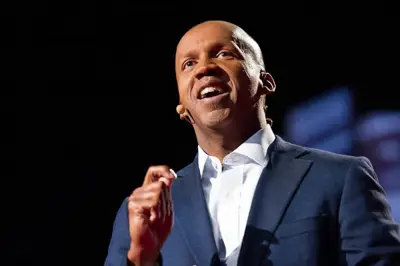
Bryan Stevenson is an American lawyer, social justice activist, founder/executive director of the Equal Justice Initiative, and a law professor at New York University School of Law. Based in Montgomery, Alabama, Stevenson has challenged bias against the poor and minorities in the criminal justice system, especially children. He has helped achieve United States Supreme Court decisions that prohibit sentencing children under 18 to death or to life imprisonment without parole. Stevenson has assisted in cases that have saved dozens of prisoners from the death penalty, advocated for the poor, and developed community-based reform litigation aimed at improving the administration of criminal justice.
