Thomas Paine Quotes
It requires but a very small glance of thought to perceive, that although laws made in one generation often continue in force through succeeding generations, yet that they continue to derive their force from the consent of the living. A law not repealed continues in force, not because it cannot be repealed, but because it is not repealed; and the non repealing passes for consent.
Paine, Thomas. Rights of Man. J. S. Jordan, 1791.


This Cahier was the consensus of the Clergy of Blois in 1789. There were cahiers of several provinces of France—some by the clergy, some by the nobles. What is fascinating is the emergence of many of the pre-revolutionary French concepts. The example of the American revolution and its principles was known throughout the educated classes of France.

This was a classic debate over universal male suffrage. Rainborough had made a forceful argument for equality as a spokesperson for the Levellers in this famous debate. Ireton (See {619711}) eloquently gave the classic counter-argument that property owners had much more at stake and therefore should have much more of a say on governmental affairs. Early America actually sided with Ireton but modern America holds with Rainborough.


Although written in 1770, it was not formally published and available until 1774


This is the earliest surviving attempt of the Romans to formulate a legal code.


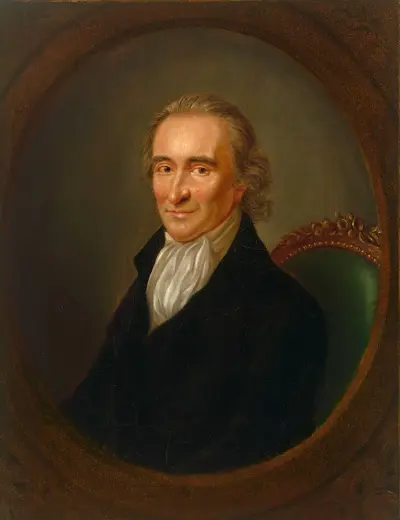
Thomas Paine was an English-born American political activist, philosopher, political theorist, and revolutionary. He authored Common Sense (1776) and The American Crisis (1776–1783), the two most influential pamphlets at the start of the American Revolution, and helped inspire the patriots in 1776 to declare independence from Great Britain. His ideas reflected Enlightenment-era ideals of transnational human rights. Historian Saul K. Padover described him as "a corsetmaker by trade, a journalist by profession, and a propagandist by inclination".
