Bertrand Russell Quotes
It is undesirable to believe a proposition when there is no ground whatsoever for supposing it is true.
3rd Earl Russell of Kingston
Bertrand Russell, 1872-1970, British Philosopher & Reformer, Quoted in David Roberts, A Newer World
Sourced by: Eigen's Political and Historical Quotations


In politics, the most frequent examples are conspiracy theories and economic and/or political principles that are derived from ideology with little or mothing real from which to provide a deducible justification. An explanation that seems not to be contradicted is not an explanation that could be called true unless there is some evidence to support it, not a lack of evidence to refute it. There are millions of propositions in the world for which there is no evidence to reject them, but that does not make them true." 3rd Earl Russell of Kingston
3rd Earl Russell of Kingston


Spinoza’s ideas were considered so radical and dangerous that he was the only man in history who was excommunicated by the Catholics, the Jews and the Muslims.


Proof in a scientific and mathematical context is very different from the legal concept of proof. For Feynman, proof consisted of both being able to deduce a statement in much the same way as a proof is offered in plane geometry and being able to construct an experiment which will demonstrate the validity (confirm the prediction of what will happen all cases. As a theoretical physicist, most of his proofs were of the mathematical, deductive kind. There are many phenomena in mathematics and science that were, and are, known long before someone was able to offer a proof.


3rd Earl Russell of Kingston

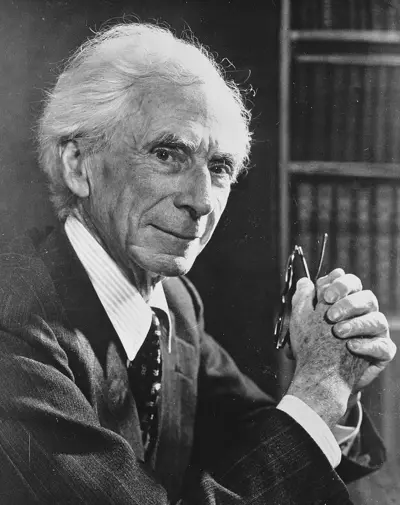
Bertrand Arthur William Russell, 3rd Earl Russell OM FRS was a British polymath, philosopher, logician, mathematician, historian, writer, social critic, political activist, and Nobel laureate. Bertrand Russell was one of the most influential and widely known intellectual figures of the twentieth century. In 1950 he was awarded the Nobel Prize in Literature for his extensive contributions to world literature and for his “rationality and humanity, as a fearless champion of free speech and free thought in the West.“
