Adam Smith Quotes
It is not from the benevolence of the butcher, the brewer, or the baker that we expect our dinner, but from their regard to their own interest.
Smith, Adam. An Inquiry into the Nature and Causes of the Wealth of Nations. W. Strahan and T. Cadell, 1776.


The implication of the investment in infrastructure and education is that the state must tax people at a rate that would pay for it. But if the rate is too high, he argues, people will not make a sufficient profit from their work.


In the late 19th century, the Sherman Antitrust Act was passed to control vicious monopolies and trusts. There were many who thought that this would be philosophically incompatible with the doctrine of free enterprise. James observed that the American philosophy required the testing of each doctrine and in the case of monopolies, the results were destructive for consumers, competitors, and society in general, with the monopolist the only beneficiary of the free enterprise where consumers and competitors lose their freedom.


Like many ideological political philosophers who developed a following, she tended to exaggerate many of her points and to ignore additional factors. While individual businessmen and politicians pursuing their self interests were certainly necessary for America’s great growth and success, they were not sufficient. Many of the founding fathers sacrificed their fortunes and in some cases their lives to gain American independence. And the sacrifice of millions was necessary in many conflicts were those who fought were rarely enlarging their own fortunes. And equally important factors of American success were the collective action of communities creating schools, roads, bridges, canals. The driver of the businessmen to move into critical areas was the government subsidizing the railroads, proving the telegraph useful, developing the national highway system and the Internet. Most of the great universities and research centers were created as government, charitable or religious institutions where personal profit was not a factor. It is that combination of private and public, self serving and communitarian drives, secular and religious that have created modern America. Many people in Rand’s ere did not credit the private, self serving contributions of many great men, and Rand led the movement to remind all of that critical factor. In the process of making her good point, she tended to ignore the other factors.
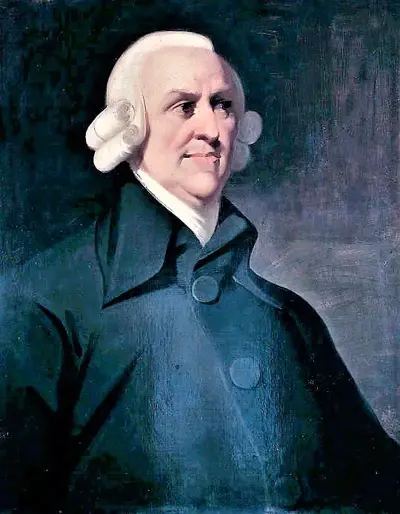
Adam Smith FRSA was a Scottish economist, philosopher as well as a moral philosopher, a pioneer of political economy, and a key figure during the Scottish Enlightenment, also known as ''The Father of Economics'' or ''The Father of Capitalism''. Smith wrote two classic works, The Theory of Moral Sentiments (1759) and An Inquiry into the Nature and Causes of the Wealth of Nations (1776). The latter, often abbreviated as The Wealth of Nations, is considered his magnum opus and the first modern work of economics. In his work, Adam Smith introduced his theory of absolute advantage.
