Lucretia Mott Quotes
It is not Christianity, but priestcraft that has subjected woman as we find her.
Mott, Lucretia. Discourse on Woman. T. B. Peterson, 1850, p. 7.


The 26 year old (young) Marx was not a great fan of collectivism in his early days.

This was a metaphorical way of criticizing the Republican Party for policies that had men controlling women’s bodies.

He served a jail sentence in Britain for inciting race hatred.
The American Catholic Bishops wanted the right of religious organizations who ran civil institutions like hospitals or universities to deny its female employees any insurance coverage for birth control while paying for Viagra for males. Artificial birth control methods were considered immoral by the Roman Catholic Church. The Bishops did not feel that their institutions should be required to follow the civil law if their religious precepts opposed it. Quinn observed that 99% of women in America use birth control and even 98% of Catholic women did. This is a wonderful example of how subtle a basic principle like separation of church and state can be. The churches themselves did not have to pay for birth control insurance, but other Catholic-related entities did. How far would the bishops take their view. If a spaghetti factory were owned by a Catholic Church, would it have to insure birth control like other spaghetti factories? What about if the factory were a public company and the church owned all the stock? Most of the stock? Part of the stock? There are no clear and simple answers to these questions.


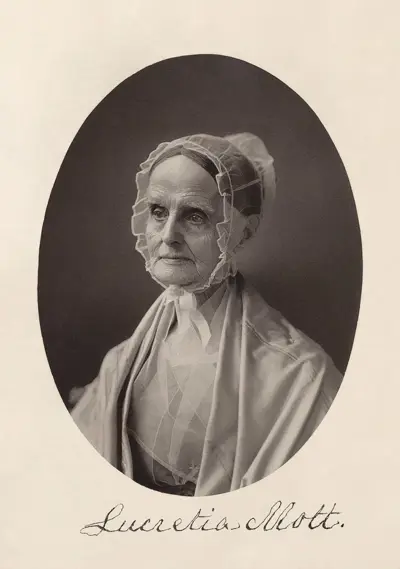
Lucretia Mott was an American Quaker, abolitionist, women's rights activist, and social reformer. She had formed the idea of reforming the position of women in society when she was amongst the women excluded from the World Anti-Slavery Convention held in London in 1840. In 1848 she was invited by Jane Hunt to a meeting that led to the first public gathering about women's rights, the Seneca Falls Convention, during which Mott co-wrote the Declaration of Sentiments.
