Homer Quotes
It is no bad thing to be a king-to see one's house enriched and one's authority enhanced.
Homer. The Odyssey. Translated by Robert Fagles, Viking Penguin, 1996, p. 89.


See {627027} for an earlier expression of this point.


The offer of Darius was to pay him ten thousand talents, to cede to him all the countries west of the Euphrates, and to give him his daughter in marriage. Parmenio had urged him to take the offer. Alexander then went on and defeat Darius and the Persions who far outnumbered his forces. Asia then had one king who was more popular than Darius had been.

Although born a noble, he was very informal and at his dinners and banquets he sat in different places at the table and not at the traditional head. When asked why, this was his reply. See {632267} for an early Spartan similar view.


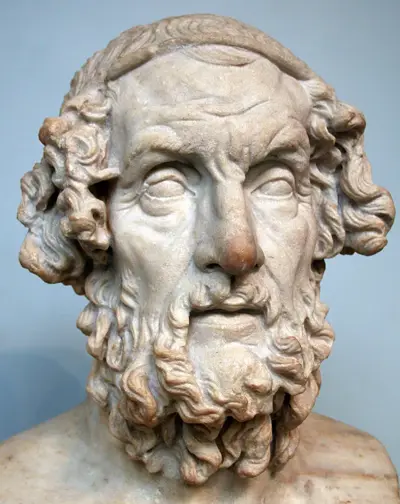
Homer (/ˈhoʊmər/; Ancient Greek: Ὅμηρος [hómɛːros], Hómēros) was the presumed author of the Iliad and the Odyssey, two epic poems that are the foundational works of ancient Greek literature. The Iliad is set during the Trojan War, the ten-year siege of the city of Troy by a coalition of Greek kingdoms. It focuses on a quarrel between King Agamemnon and the warrior Achilles lasting a few weeks during the last year of the war. The Odyssey focuses on the ten-year journey home of Odysseus, king of Ithaca, after the fall of Troy. Many accounts of Homer's life circulated in classical antiquity, the most widespread being that he was a blind bard from Ionia, a region of central coastal Anatolia in present-day Turkey. Modern scholars consider these accounts legendary.
