Horace Quotes
It is difficult to administer properly what belongs to all in common.
Horace. Satires, Epistles and Ars Poetica. Translated by H. Rushton Fairclough, Harvard University Press, 1926, p. 461.

The Catholic view on the subject varied from time to time, even with the same Pope. See {638558} for another quote from this Pope that gives a different point of view.


Spinoza was one of the most feared intellectuals in human history—feared, that is, by the established power structures. He is the only known person who was excommunicated by the Catholics, the Jews and the Muslims—all were forbidden to read his works. He was the enemy of authority and advocated personal reason as the guide for men.


The founder was Charles E. Coughlin, 1891-1979, a demagogic Catholic Priest who drafted the principles and invited others to join him. Hundreds of thousands did in this organization which began in idealism, and ended in scandal and hate mongering, so much so that Father Coughlin was ordered off the radio and out of politics by the Catholic Church. The National Union in 1936 had morphed into the Union Party which ran Presidential candidates in the 1936 election. The Coughlin and the Union were a mixture of Fascist and Socialist principles. The prohibition of private ownership of banks and utilities was one of the radical socialist notions.

Executed by the English for his part in the Easter Uprising.
The Diggers were a religious-economic movement that even today would be considered very radical. They advocated the right of the poor to go onto public lands and farm them—thus the name “Diggers.” Beyond their opposition to the private ownership of land to the exclusion of the poor, Winstanley and the Diggers promulgated another very modern doctrine: That the poor should take the responsibility and have the right to determinine how the society should provide for the poor. A version of this became one of the Mottos of the Poverty Program of 1964. See {616966}.
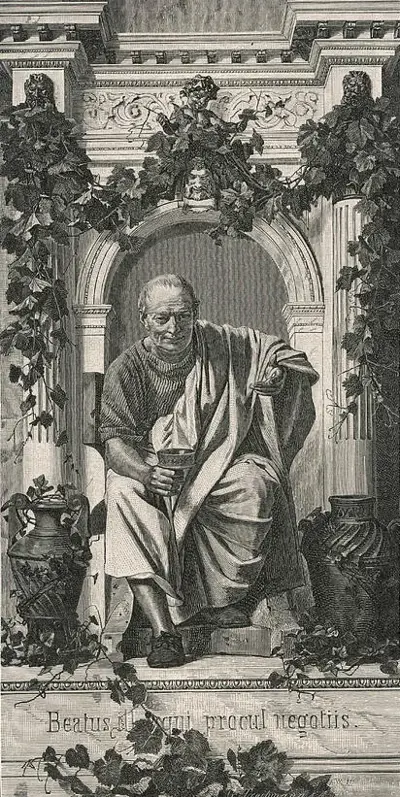
Quintus Horatius Flaccus, known in the English-speaking world as Horace (/ˈhɒrɪs/), was the leading Roman lyric poet during the time of Augustus (also known as Octavian). The rhetorician Quintilian regarded his Odes as just about the only Latin lyrics worth reading: "He can be lofty sometimes, yet he is also full of charm and grace, versatile in his figures, and felicitously daring in his choice of words."
