Aristotle Quotes
It is clear, then, that the earth must be at the centre and immovable, not only for the reasons already given, but also because heavy bodies forcibly thrown quite straight upward return to the point from which they started, even if they are thrown to an infinite distance. From these considerations then it is clear that the earth does not move and does not lie elsewhere than at the centre.
Aristotle. On the Heavens. Translated by J. L. Stocks, Clarendon Press, 1922, p. 296b.


While critics of Islam cite this sura to show how absurd the Koran can be and contradicts what is known about the Earth’s orbit, few sophisticated, moderate Muslims believe this. However, even in the United States there are many Christians and Orthodox Jews who not only deny Evolution but also believe the Earth is 6000 years old. The basic difference is that in Islamic countries publicly critiquing such anti-scientific theological statements is rare and an individual who publicly argues against the Koran taken literally is often in danger from state or private retribution. In the West the conflict between the Bible and known science is not only publicly commented upon but in a somewhat derisive way. However, consider this: Islam is about 1500 years old. When Christianity was the same age, Galileo was tried and convicted by the Catholic Church for denying this very statement. Perhaps in another 700 years Muslims will look back with embarrassment on this as most of Christianity does.

The Church no longer believes this of course. Having learned from this unfortunate experience and Galileo’s persecution, today the Roman Catholic Church is one of the more advanced religious institutions in accepting modern science.


The Roman Catholic Church had stultified scientific thinking for over a thousand years where differing with accepted church doctrine was not only discouraged but was dangerous. Even though Hicletas—see {590328}—realized that the earth rotated around its own axis three centuries before Christ, and his view was in the literature to which learned people had access, even in 1543 Copernicus had to tread lightly with the church. He enlisted the aid of the Pope to “response block” the opposition of other church authorities. Galileo later did not play politics and had a more narrow minded Pope and Vatican to contend with, and as the world knows, came into unfortunate conflict with the Church.

This quotation illustrates how scientifically sophisticated some of the Founding Fathers were.


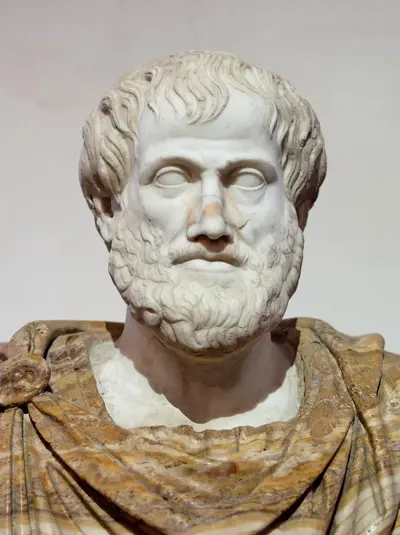
Aristotle (/ærɪˈstɒtəl/; Greek: Ἀριστοτέλης Aristotélēs, pronounced [aristotélɛːs]; 384–322 BC) was a Greek philosopher and polymath during the Classical period in Ancient Greece. Taught by Plato, he was the founder of the Lyceum, the Peripatetic school of philosophy, and the Aristotelian tradition. His writings cover many subjects including physics, biology, zoology, metaphysics, logic, ethics, aesthetics, poetry, theatre, music, rhetoric, psychology, linguistics, economics, politics, meteorology, geology and government. Aristotle provided a complex synthesis of the various philosophies existing prior to him. It was above all from his teachings that the West inherited its intellectual lexicon, as well as problems and methods of inquiry. As a result, his philosophy has exerted a unique influence on almost every form of knowledge in the West and it continues to be a subject of contemporary philosophical discussion.
