Richard P. Feynman Quotes
It is always good to know which ideas cannot be checked directly, but it is not necessary to remove them all. It is not true that we can pursue science completely by using only those concepts which are directly subject to experiment.
Feynman, Richard P., Robert B. Leighton, and Matthew Sands. The Feynman Lectures on Physics, Volume III. Addison-Wesley, 1965, p. 2-8.


Myths include the then accepted scientific, political, and religious teachings.

He was addressing the misunderstanding that many laypeople and most anti-evolutionists have that if Evolution is only a theory why put so much stock in it. The layman often uses the word “theory” in opposition to “fact.” But to the scientist theories are of different types—those that are as of yet speculation and those for which a strong body of evidence exists. Evolution, like Relativity, has a huge amount of evidence supporting it. Yet in time every good scientist knows that all these proven theories will be modified with new knowledge. Relativity has been demonstrated as having errors initially by Einstein himself. The essence of these things are true although elements change. The early law of gravity is the best example. We know that it is wrong in many, circumstances—in space for example. But it, none the less, is fundamental to much analysis and with our much more sophisticated understanding of it we still talk of the “Law” of gravity even though we realize that it is not quite correct in all circumstances.


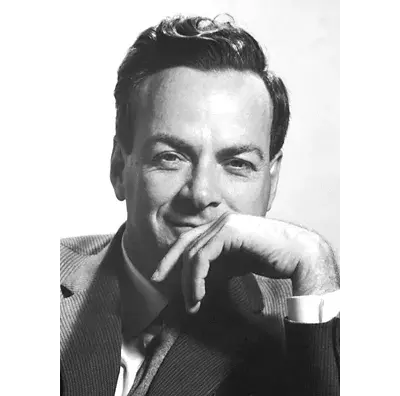
Richard Phillips Feynman was an American theoretical physicist and Nobel Prize winner who made significant contributions to quantum mechanics, quantum electrodynamics, and particle physics. He's known for his work on the Manhattan Project, developing Feynman diagrams, and explaining the interactions between light and matter. While studying for his PhD, Feynman participated in the Manhattan Project and helped develop the atomic bomb. For contributions to the development of quantum electrodynamics, Feynman received the Nobel Prize in Physics in 1965 jointly with Julian Schwinger and Shin'ichirō Tomonaga.
