Benjamin Harrison Quotes
It is a reproach to our civilization that any class of American workmen, should in the pursuit of a necessary and useful vocation, be subjected to a peril of life and limb as great as that of a soldier in time of war.
He could not get any legislation protecting the workers but Theodore Roosevelt did in 1906--Employers’ Liability Act of 1906 but rapidly the Supreme Court declared it unconstitutional as it was the first federal mandate that had ever been placed on employers. Roosevelt then had the legislation rewritten to get around the Supreme Court objections and that was passed in 1908 and was not overturned. See {640536}.
Benjamin Harrison, 1833-1901, 23rd President of the United States (Republican, IN), Referring to railroad workers, Quoted in "About The Federal Employers' Liability Act (FELA)", http://www.railroadinjurylawyers.org/about fela
Sourced by: Eigen's Political and Historical Quotations

President Harrison had first brought the problem of injured workers having no protection or recourse to public attention {640537} Then Roosevelt’s term created legislation and the Congress passed it. The very conservative Supreme Court had declared the Employers’ Liability Act of 1906 unconstitutional, leaving no recourse of assistance for American railroad employees injured on their job through no fault of their own. Roosevelt was furious and he had the legislation redrafted to get around the Supreme Court objections. and that was passed in 1908 and was not overturned.

Most mine safety initiatives have only been passed or implemented after a major mine disaster. This type of inertia, in most fields, is unfortunately typical of legislative calendars and agendas where only a few items are high priority at any one time.

At the time, the mine owners and operators claimed that they had NO obligations to their workers—not even to ensure a safe mine. There was no OSHA and workers died and were maimed on the job much more frequently than they do today. Many mine owners now accept that they have obligations to the workers, and the rest are required to have responsible and safe working conditions by law and OSHA regulations.


At the time there was very little such legislation or regulation, and the little there was only occurred after massive lobbying efforts by organized labor. In modern times, often it takes a horrible tragedy to occur before the political will can be mobilized to cope with issues of occupational health and safety.
As hard as it is to understand today, there were few states with safety laws governing industry. There was no OSHA (Occupational Safety and Health Administration ) or other federal regulation of industrial safety conditions.


Six of his miners were killed in a Utah mine accident and three more died trying to rescue them. Although a coal mine owner, he also questions the values of our society, the coal mining industry, and his company—all of which accept the fact that coal mining is a very hazardous enterprise while many argue that we should just use safer energy sources.


In 1902 there was a major coal and railroad labor crisis. The owners and operators refused to negotiate or bargain with labor: This quotation is very famous because it is an iconic picture of the views and attitudes of the large industiralists at the turn of the 20th Century. More than opposing labor unions, they actually believed that God had selected them to run the economic and business affairs of the country if not the world. It was their Christian values and paternalism that the workers should look to in order to determine the rights and priviliges of the working man or woman. This upper class attitude was one of the major reasons that class warfare broke into the open. Ironically, there was not much difference between the attidudes of the industiral leaders and the notions of fudalism.

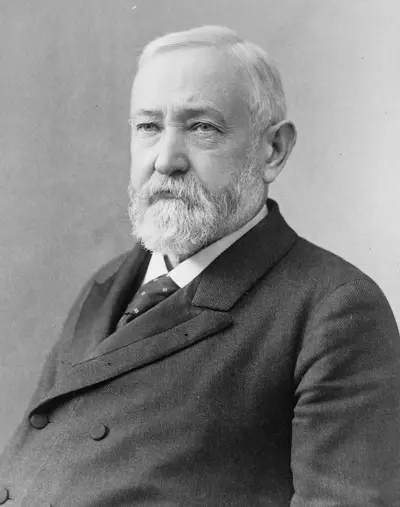
- Born: August 20, 1833
- Died: March 13, 1901
- Nationality: American
- Profession: President
Benjamin Harrison was an American politician and lawyer who served as the 23rd president of the United States from 1889 to 1893. He was a grandson of the ninth president, William Henry Harrison, and a great-grandson of Benjamin Harrison V, a founding father who signed the United States Declaration of Independence.
