Fulton J. Sheen Quotes
It is a long established principle of the Church never to completely drop from her public worship any ceremony, object or prayer which once occupied a place in that worship.
Sheen, Fulton J. This Is the Mass. Hawthorn Books, 1958, p. 30.


This is a classic example of institutional reluctance to examine history in the light and morality of the present. Nations have difficulties coming to grips with their pasts just as Churches and other institutions do.

What is particularly interesting about this quotation is the date. As late as 1932, a governor of a major state, was declaring a State holiday for a particular religion, and in his official capacity was recommending fasting and paryer within a Christian context. Although the Proclamation violated the First Amendment, at the time few people would make the effort to go to court to challenge what had been a long tradition in America of declaring Christian Holidays official and the keeping of the Sabbath with criminal penalties for those who did not. However, it took time, effort and money to challenge these practices in court, and the majority community did not treat those people well socially who challenged custom as unconstitutional even when the courts agreed and restrained the practice. Even into the 21st century there were still a few legal battles about prayer in schools and promulgating Biblical passages in public buildings. From the late 1800s to the latter part of the 20th century, it was the Democrats who attracted most religious Americans while the Republicans were the party who advocated a non-traditional but Constitutional approach to religion. See {623322}


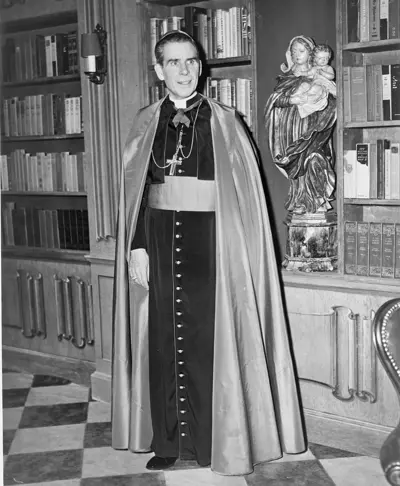
Fulton John Sheen was an American bishop (later archbishop) of the Catholic Church known for his preaching and especially his work on television and radio. Ordained a priest of the Diocese of Peoria in 1919, Sheen quickly became a renowned theologian, earning the Cardinal Mercier Prize for International Philosophy in 1923. He went on to teach theology and philosophy at the Catholic University of America as well as acting as a parish priest before being appointed Auxiliary Bishop of the Archdiocese of New York in 1951. He held this position until 1966 when he was made the Bishop of Rochester. He resigned in 1969 as his 75th birthday approached, and was made the Archbishop of the titular see of Newport, Wales.
