Ludwig von Mises Quotes
It cannot be denied that Fascism and similar movements aiming at the establishment of dictatorships are full of the best intentions and that their intervention has, for the moment, saved European civilization. The merit that Fascism has thereby won for itself will live on eternally in history.
Mises, Ludwig von. Liberalism: In the Classical Tradition. Translated by Ralph Raico, Foundation for Economic Education, 1985, p. 51.


Hayek uses this line to explain that fascism may emerge when communism—or belief in its promise—fails, as seen in Stalinist Russia and pre‑Hitler Germany.


American Communist Party Newspaper. The communists were so supportive of the war effort that they were often unconditional defenders of the Roosevelt Administration’s war program. Most communists suspended their advocacy of labor strikes and Black enfranchisement during the war because it would ultimately lead to the weakening of the Allied efforts against the Nazis. Programs such as the “March on Washington Movement” were seen as untimely and therefore subversive and fascist. For more communist criticism of attempts during this period to further civil rights see {603312}

Many notables of the left and the right supported Mussolini in his early political days. Virtually all of the worst dictators were welcomed by many when they first appeared on the scene. Human nature seems to have us all looking for exceptional leaders and statesmen and that is exactly what the dictator relies upon to acquire power, By the time most recognize the truth, the dictator has control of all the levers of compulsion. Many Americans were fooled just as the Europeans were. For others, see {623202}. {623200} and {623201}.

This quotation brought Mises much criticism at the time and has destroyed his moral credibility for the rest of his career. Like many others who supported the wealthy ruling classes, he expressed admiration for Fascism. Worse he claimed that Nazi German and Italian Fascism saved Europe when subsequent events proved that they destroyed Europe along with 30-40 million people killed. However, unlike most of the right wing Fascist enthusiasts of the day, he did—in the last sentence of this quotation which is often omitted by critical quoters—observe that Fascism success would not be permanent or long lived. His lack of moral condemnation of Fascism and Fascists however was clear. Some of his apologists and decuples observe that his philosophy tended to avoid all kinds of moral judgments pro and con about almost everything. It was this lack of a moral / ethical framework that most of his critics point to as a great failing of his. Also, many argue that this is another example of Mises tendency to exaggerate. Mises also took great criticism on what he claimed were “best intentions”; this included virulent racial and religious discrimination, militarism, aggression and expansionism, persecution of the handicapped. Ironically much later, Mises admitted that all of the Nazi evil was clear before it was implemented, {632449}. Some scholars think that Mises who was almost amoral outside the context of economics, began to develop a moral awareness in the reality of the Nazi charnel that much of Europe had become. One problem is that a person like Mises loses much credibility because of his lack of moral sensibilities and moral perception of a way of life and then exaggerates so many of his examples. However, many of his ideas and insights are very important in man’s quest of an economic system that produces substantial increases in standard of living and development and at the same time assure a modicum of subsistence and dignity and a fair opportunity to achieve much more. Mises’s ideas should not be ignored because of the failings of Mises the man.


Fascists were variously described as “brown shirts” or “black shirts” at the time.

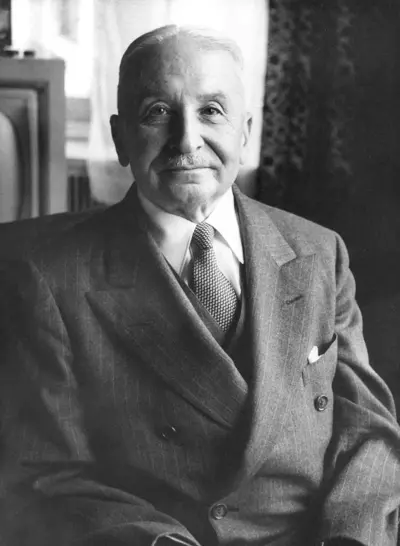
Ludwig Heinrich Edler von Mises was an Austrian School economist, historian, logician and sociologist. Mises wrote and lectured extensively on the societal contributions of classical liberalism. He is best known for his work on praxeology, a study of human choice and action.
