Elliott Abrams Quotes
Israel will not and should not leave until it is clear that the West Bank can be policed by Palestinians and that the region will not be a source of terrorism against Israel, as Gaza and South Lebanon became when Israel left there.
Abrams, Elliott. Tested by Zion: The Bush Administration and the Israeli-Palestinian Conflict. Cambridge University Press, 2013.


Netanyahu’s response when asked by a reporter what he thinks of President Donald Trump’s proposal for the US to take over and rebuild the Gaza Strip. Controversially, the proposal also includes removing Palestinians to neighboring Arab countries.


Hamas had, in a bloody armed coup, seized control of the Gaza Strip from the Palestinian Authority, and refusing to negotiate with the Israelis undermined the Palestinian hopes of peace talks with Israel. The PA could no longer speak for the Palestinians. Hamas a particularly aggressive terrorist organization whose charter called for the death of all Jews in the world, wanted to force the Palestinian Authority to join them in terrorist attacks on Israel. The Palestinians had renounced terrorism and violence. The Hamas fighters were planning to fire rockets at Israel from the West Bank and launching other terrorist attacks against Israel, hoping that Israel would retaliate against the Palestinian Authority by attacking the West Bank which had not been destroyed at all while Gaza had lost much of its infrastructure and 2,000 lives. The Palestinian Authority was not about to let themselves get sucked into a war that they could not possible win and was contrary to the policies of Prime Minister Abbas and his elected government.


In the complicated and arcane Middle East, substantial majorities of Israelis and Palestinians both favored a two state solution, thus creating a Palestinian State out of the West Bank and Gaza. However, the Hamas terrorist organization won the majority of seats in the Parliament and formed the “government” of the Palestinian Authority. Hamas opposed Israel’s right to exist at all, as that position as well as virulent Anti-Semitic threats to all Jews in the world. Many called for Hamas to change their charter and crease their opposition to the right of Israel to exist. The President of the Palestinian authority called for new elections but Hamas refused. Thus Blair and other diplomats the world over were in a very difficult situation.

The Palestinians were split between supporters of Hamas and Fatah. The former was a terrorist organization which refused to recognize the right of Israel to exist and whose charter called for the killing of all Jews. The latter, accepted the right of Israel to exist and was committed to peace and coexistence with the Jewish state. They had fought a civil war and Hamas controlled Gaza with well over 1 million people which they seized for force and killed of forced out Fatah Representatives. Fatah was the elected ruling party of the West Bank, the larger and more populous of the Palestinian territories. There was little chance of any peace given that split. However, Israel which had undergone over 7000 rockets fired upon them by Hamas, stated that they refused to negotiate with the Palestinians as long as the Hamas terrorists were a part of the control of the potential Palestinian state. They would only discuss a 2 state solution if Hamas agreed that they accepted the right of Israel to exist in their general territory as a Jewish State, Hamas would accept and follow previous agreements made with the Palestinians, and Hamas would give up terrorism and the objective of killing Jews. So either Hamas would have to change its policies or Israel would negotiate with an organization that claimed it would never accept the existence of that country as a Jewish state. Al-Masri thought that the agreement he had mediated, was a necessary first step and was constructive for all the parties.
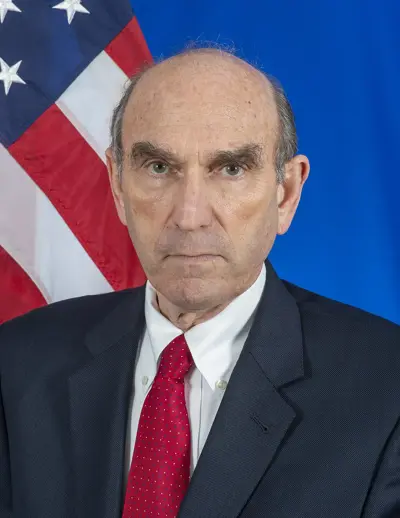
Elliott Abrams is an American politician and lawyer, who has served in foreign policy positions for Presidents Ronald Reagan, George W. Bush, and Donald Trump. Abrams is considered to be a neoconservative. He is currently a senior fellow for Middle Eastern studies at the Council on Foreign Relations. On January 25, 2019, he was appointed as Special Representative for Venezuela. On September 1, 2020, he was further appointed to concurrently serve as the U.S. Special Representative for Iran.
