William Apess Quotes
Is it not because there reigns in the breast of many who are leaders a most unrighteous, unbecoming, and impure black principle, and as corrupt and unholy as it can be--while these very same unfeeling, self-esteemed characters pretend to take the skin as a pretext to keep us from our unalienable and lawful rights?
William Apess, 1798–1839, Native American (Pequot) Writer, An Indian's Looking-Glass For The White Man
Sourced by: Eigen's Political and Historical Quotations


Mather was urging the community to protect their children against the Devil and his band. To exemplify just how terrible Devils were to his audience, he used a comparison to the worst thing the audience was familiar with—Indians. Although there were a few examples in Colonial America of Indians being perceived as benign or even people, they were few and far between, and tended to be in New York and Pennsylvania.

His solution was not to change the prejudice or improve the opportunity for Blacks but to have complete separation of the races. See {625687}.

She was one of the first prominent white southerners to denounce racial segregation.


[This was the first Abolition appeal written by a Black Man. It was published in Boston and despite the fact that it was very critical of whites, was very popular going through two more printings within the next two years.]


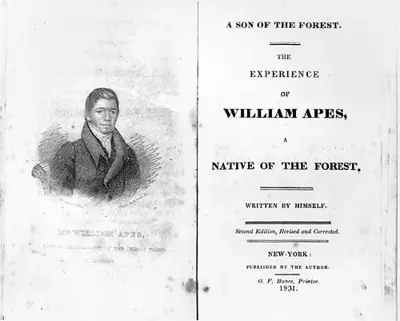
William Apess (1798–1839, Pequot) (also known as William Apes before 1837), was an ordained Methodist minister, writer, and activist of mixed-race descent, who was a political and religious leader in Massachusetts. After becoming ordained as a Methodist minister in 1829, he published his autobiography the same year. It is among the first autobiographies by a Native American writer. Apess was part Pequot by descent, especially through his mother's family, and identified with their culture.
