John Polanyi Quotes
Individual scientists like myself - and many more conspicuous - pointed to the dangers of radioactive fallout over Canada if we were to launch nuclear weapons to intercept incoming bombers.
Polanyi, John C. The Dangers of Nuclear War. Edited by Franklyn Griffiths and John C. Polanyi, University of Toronto Press, 1979.


The alternative deterrent was to maintain an army of over 2 million men overseas in both Europe and Asia, and the cost was much greater than the then perceived cost of nuclear weapons. At the time no one figured the cost of coping with the radioactive material and waste as well as the cleanup of nuclear bomb factories like Hanford. These costs were still not known byt the 21st century.


This quotation represents a colossal failure of politicians to understand science and the way that it works. They assumed that the processes and methods were secrets that if kept secret, would prevent others from constructing an atomic bomb. The reality was that the most important “secrets” had emanated from Einstein’s Theory of Relativity and other published scientific papers. So any competent physicist knew immediately how the bomb worked. A triggering mechanism would need to be developed but that was just a complicated engineering project. The largest barrier was the supply of enough radioactive material with sufficient purity. That then (as today) took a lot of money and some time. But after the initial bomb, the secrets might speed things up but were not necessary. That is why the French and the Russians quickly developed their bombs, and why it did not take the Israelis long once the had decided to invest the resources. China, India and Pakistan did not need the secrets either when much later, they decided to develop nuclear weapons. With the atomic bomb, spying and obtaining secrets shorten the required time and reduce the cost, but are not necessary. This is why nuclear proliferation is so hard to stop.


Only three days later the Russians detonated their first atomic device.

This quotation is very important in helping to understand the 1950s in America with respect to nuclear weapons policy. McCormick was one the better educated, sophisticated, and influential Americans. Yet he appears to be a technological and nuclear ignoramous. Most people had not yet realized that atomic weapons were not just much larger traditional bombs. They could do terrible damage, but it would always be localized they thought. Chicago might be destroyed but the people out of range would be OK. He never got it that a dirty bomb could be dropped on Detroit and depending on which way the wind is blowing could wipe out Chicago and much of the Midwest as well. He knew nothing of the genetic effect the radiation, nor the implications for the environment of maintaining a large nuclear manufacturing industry. He and many like him did not realize that after the first bombs were created, how easy it would be for the Russians and others to also develop a nuclear arsenal. And 50,000 warheads was just a matter of effort. The implications of these things would inhibit our carrying out his and others ideological views of foreign policy. Oppenheimer and most nuclear scientists explained all this, but believing them and acting on those beliefs would have been too much of a change.
3 days later, President Truman, announced that the Russians had successfully developed an atomic weapon. This quotation gives us another example where the Central Intelligence Agency failed to predict and/or warn America about a crucial event. Others included the North Korean invasion of South Korea, the Arab Spring, the Soviet invasion of Afghanistan, the fall of the Berlin wall, and the collapse of the Soviet Union.


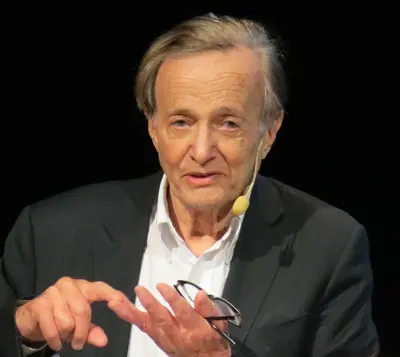
John Charles Polanyi, PC CC FRSC OOnt FRS is a Hungarian-Canadian chemist who won the 1986 Nobel Prize in Chemistry, for his research in chemical kinetics. Polanyi was born in Berlin, Germany prior to his family emigrating in 1933 to the United Kingdom where he was subsequently educated at the University of Manchester, and did postdoctoral research at the National Research Council in Canada and Princeton University in New Jersey. Polanyi's first academic appointment was at the University of Toronto, and he remains there as of 2019. In addition to the Nobel Prize, Polanyi has received numerous other awards, including 33 honorary degrees, the Wolf Prize in Chemistry and the Gerhard Herzberg Canada Gold Medal for Science and Engineering. Outside his scientific pursuits, Polanyi is active in public policy discussion, especially concerning science and nuclear weapons. His father, Mihály (Michael), was a noted chemist and philosopher. His uncle Karl was an economist. According to György Marx he was one of "The Martians", a group of prominent Hungarian scientists who emigrated to the United States in the first half of the 20th century.
