Joseph M. Street Quotes
Indians are very curious and like to see and feel all who are placed near them. They remain as yet very quiet and those who come to visit bring furs and venison. I am, as you know, a novice in Indian affairs.
While some of the Indian agents were dishonest and stole as much as they could, others like Street, meant well but had no experience or preparation for the job.
Joseph M. Street, 1780-1840, Newspaper Publisher, Indian Agent to the Winnebago in Wisconsin, Letter to the Governor of Wisconsin, November 27, 1827
Sourced by: Eigen's Political and Historical Quotations


Not all Indians resented the coming of the white man. Several of the more peaceable tribes benefiting by interactions with the United States and some even sought affiliation—especially the military weaker tribes which would be protected by an alliance with the Americans.


One of the great successes of the expedition was the result of Lewis and Clark not only following these instructions but going to extremes of avoiding violence in almost all cases despite some provocation.

Miller was the first Black American admitted to a Graduate Program—Johns Hopkins—in Mathematics
The reason for the secrecy was that he was informing Congress of the Lewis & Clark Expedition. Potentially, the Spanish, English or French might try to interfere with the expedition which was the precursor to American domination of the entire continent. Unfortunately, Jefferson’s plan for the Indians was not supported by many other Americans with the exception of New York State and the Iroquois remaining after many left after supporting the British in the Revolution. But the Iroquois who remained were already farmers in fixed communities and were experienced traders. Further, they had a complex governmental structure with many elements of democracy, and several had already succeeded in European educational settings. Their successful integration with the rest of New York can be demonstrated by the fact that New York is the only state where the average Native American Income is the same as the average white income, and there is no Indian gaming in New York. Jefferson’s vision, unfortunately, was never implemented in early the Westward Expansion.

President Thomas Jefferson and the Congress worked at making a workable set of relationships with the Indians. Here Congress gave Jefferson a fund so that he could invite influential Indian leaders to Washington and give them presents. The hope was that the Indian leaders would see the achievements of white society and then work to transform their people to this more desirable way of life. While this was a good strategy with a few Indian nations, the reaction of most Indian leaders was being very impressed but not really wanting to trade their existing lifestyle, customs and values for the undeniable advantages that American society could bring. Both the white and Indian leadership miscalculated, Jefferson believed that as soon as the Indian leaders could examine the two alternative societies, they would clearly choose to change. The Indians were so impressed with the sincerity, reasonableness, and friendliness that the white leadership exhibited, that the Indians did not realize that a large part of white society was different from the leadership and that the leaders spoke for and could control the other whites.
By 1887 the government behavior towards Indians had come far from the Andrew Jackson days of Indian Removal and the government and reformers were trying to do better with Indian policy. This law was very well intended, and yet angered some Indians and tribes Where there was good agricultural or grazing land, the law required that the land be divided amongst the individual Indians who would thereafter own the deed and control the land. The problem had been that there was no concept of individual land ownership in most tribes. There were no deeds and whites would buy land unknowingly (and sometime knowingly who claimed to (or did) speak for the tribe. With this law, farm and grazing land would pass to the ownership of individual Indians. There are over 500 different Indian tribes—nations in America and they are very diverse. This law was good for some tribes and negative for others. With no communal say in the use of the land, the reservation was like a white farming community where the individual was dominant and not the town, group or culture. It minimized the dependency that Indians had on each other and the group. Within individual tribes there were often those Indians who preferred collective ownership and those who preferred individual ownership as provided in this legislation.

This quotation is often used as the greatest evidence the white usurpation of Indian land and the dubious value of all the treaties that had been made with the Indians guaranteeing them specific lands. Jackson, however, was not completely accurate. The Iroquois who fought on the American side in the Revolution were still on their lands in New York State. However, the Iriquois had their dealings with the State and local governments, and fared better than those tribes that depended in the Federal Government—especially with racists like Jackson in the Presidency.


The economic development contribution of military spending is not new and not limited to today’s military bases and defense contracts and plants. See {623902} for Sheridan’s famous prediction.

Wayne played so many parts depicting whites in the process of expanding Westward that many people saw him as an expert on the history of the Westward Expansion. He did not comment on the whites who then kept huge ranches “selfishly” for themselves or those who selfishly would not share the mineral rich land that they had taken with anyone including the original Indian owners. So in this view, the Indians should have not been capitalists but they should have been socialists and shared their resources.


See {633119} for the basic provision of the Dawes Act.
John Sutter was an immigrant to California from Switzerland where he became a Mexican citizen. Slavery was outlawed in Mexico and its territories, yet Sutter and others maintained Indians as slaves. The Roman Catholic Missions of California also kept Indian slaves. This quotation is historically important because many people never realized that slavery was prevalent in California.
The whites had constantly encroached on the Cherokee land which was too large for any reasonable patrolling by the Indians themselves. The Federal government persuaded the Cherokee to sign a treaty by which the Indians would give up their title to the larger part of their land. The most important quid pro quo was that the Federal Government would protect the remainder of the Cherokee land from incursion by whites or even other Indians. However, whites who coveted the land started to encroach and build farms and ranches. The Federal government was reluctant to use American soldiers against American citizens and was looking for a way out. However, the Cherokee chiefs were reminding them of their obligation. The state governments were less concerned about Federal treaties, and Georgia passed a law that said that all the Cherokee land must be governed by State Law contrary to the Treaty which gave the Cherokee total sovereignty. But the Feds were not anxious to have a showdown with the states on this issue. Whites, with the connivance of the state governments and the support of some Federal Officials offered to amend the treaty with the Cherokee. The whites would pay the Indians fair market value for their land in the East. The Federal Government would provide equal amount of land in the Indian Territory of Oklahoma, then a territory. The Feds would assist with the relocation and provide troops to protect the Cherokee from thieves and raiders—whites and Indians, and would guarantee that the Cherokee would be completely sovereign in the new land. The chief’s did not want to renegotiate the old treaty—they just wanted it enforced. The Supreme Court ruled in their favor, but President Jackson, ignored the ruling and forced the Cherokee onto the Trail of Tears for Oklahoma and the whites took over the valuable Cherokee land.
Most of the American Indian Tribes did not practice slavery. These two were very large tribe exceptions. There were also some tribes which would capture a prisoner and maintain them by coercion, but typically these captives could be adopted and have the same rights and freedoms and obligations as other tribe members. The Cherokee and Comanche practiced the Southern white style of chattel slavery.

Earlier in his life, the President had very racist views towards the American Indian as can be seen in {588991}. However, in his regiment he organized—the Rough Riders—for the Spanish American War, there were a number of Native Americans who acquitted themselves with distinction and Roosevelt had a change of mind and heart. Further he was somewhat older and had time to reflect on the irrationality of his earlier view.

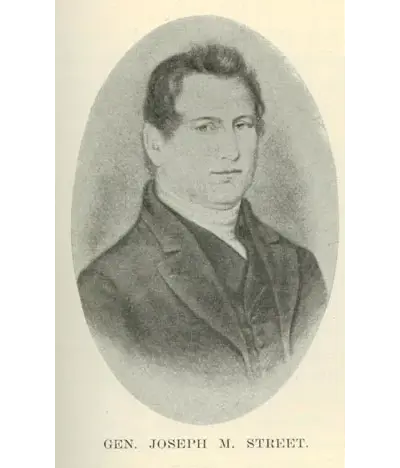
General Joseph Montfort Street was a 19th-century American pioneer, trader and US Army officer. During the 1820s and 1830s, he was also a U.S. Indian Agent to the Winnebago and later to the Sauk and Fox tribes after the Black Hawk War. His eldest son was Joseph H. D. Street, the first appointed registrar of the Council Bluffs Land Office in western Iowa.
