Simon Singh Quotes
Indeed, nobody is close to developing a general formula that predicts the number flips required for any given number of pancakes.
Singh, Simon. The Simpsons and Their Mathematical Secrets. Bloomsbury, 2013, p. 159.


Historically, in the first half of the 20th century, nuclear scientists discovered that probability governed and was necessary for understanding quantum mechanics—the laws of physics governing tiny objects like atoms, electrons, protons and even quarks. To many, this seemed a contradiction in that it was hard to conceive particles following laws and yet behaving randomly at the same time. However, it did not take long before all the scientists adjusted their thinking and learned to live and work with that was then a type of contradiction but is no longer thought so as men and women have learned to think in a new way. This quotation illustrates that the greatest scientists in the world, in a very short period of time, had to change their entire mode of thinking. There were no real holdouts or “conservatives” who wanted to maintain the older values. This would never happen in politics, where change is not accepted very quickly.


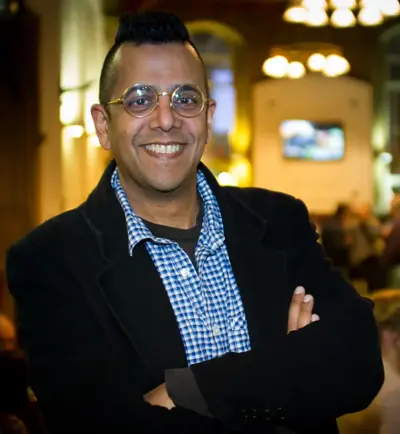
Simon Lehna Singh, MBE is a British popular science author, theoretical and particle physicist whose works largely contain a strong mathematical element. His written works include Fermat's Last Theorem (in the United States titled Fermat's Enigma: The Epic Quest to Solve the World's Greatest Mathematical Problem), The Code Book (about cryptography and its history), Big Bang (about the Big Bang theory and the origins of the universe), Trick or Treatment? Alternative Medicine on Trial (about complementary and alternative medicine, co-written by Edzard Ernst) and The Simpsons and Their Mathematical Secrets (about mathematical ideas and theorems hidden in episodes of The Simpsons and Futurama). In 2012 Singh founded the Good Thinking Society, through which he created the website "Parallel" to help students learn mathematics.
