Lene Hau Quotes
Incidentally, think about the ramifications of storing data on light waves that can be stopped and started at the speed of light.


This is a classic attempt to argue against a technical proposed policy that the Senator did not understand. While most of the new digital companies favored net neutrality, the telephone companies opposed it as they wanted to be able to discriminate among customers in providing Internet access. One of the telephone companies had obtained Steven’s support for the anti Net Neutrality position. They must have explained some technical reasons to him, and this speech was his understanding of the concept. To those who know something technical about the Internet and digital transmission, this is so crude and wrong that it is humorous.


This is one of the great perceptions of what was to come in computing.


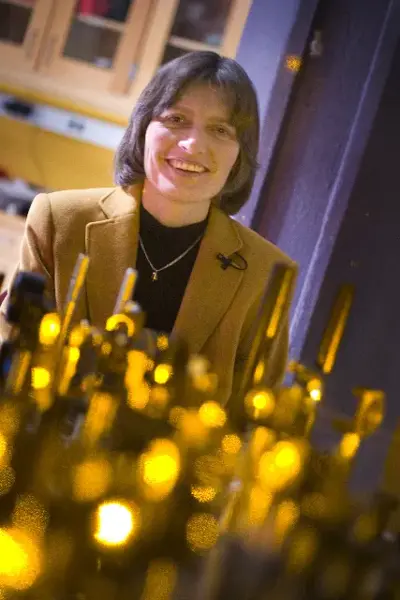
Lene Vestergaard Hau is a Danish physicist who is currently the Mallinckrodt Professor of Physics and of Applied Physics at Harvard University. She received a PhD from Aarhus University. In 1999, she led a Harvard University team who, by use of a Bose–Einstein condensate, succeeded in slowing a beam of light to about 17 metres per second, and, in 2001, was able to stop a beam completely. Later work based on these experiments led to the transfer of light to matter, then from matter back into light, a process with important implications for quantum encryption and quantum computing. More recent work has involved research into novel interactions between ultracold atoms and nanoscopic-scale systems. In addition to teaching physics and applied physics, she has taught Energy Science at Harvard, involving photovoltaic cells, nuclear power, batteries, and photosynthesis. As well as her own experiments and research, she is often invited to speak at international conferences, and is involved in structuring the science policies of various institutions. She was keynote speaker at EliteForsk-konferencen 2013 ("Elite Research Conference") in Copenhagen, which was attended by government ministers, as well as senior science policy and research developers in Denmark. In acknowledgment of her many achievements, Discover Magazine recognized her in 2002 as one of the 50 most important women in science.
