Peter Bergen Quotes
In Yemen, the United States conducted more drone strikes in 2016 than any year except 2012, the peak of the campaign in the country, according to data collected by New America.
Bergen, Peter. "Yemen's Drone War." CNN, Cable News Network, 2017.


There was extensive hostility expressed by civilian populations in Pakistan and other countries where the United States made Drone strikes to take out terrorist leaders. However, there was much anti-American feeling in Pakistan before the Drone strikes.


Executive Order 12333 prohibits political assassinations. The administration took the position that the prohibition did not apply to war where assassination (targeted killing) of enemy leaders is clearly permitted. The problem was that the George W. Bush Administration did not classify the “War on Terror” as a war. They didn’t want to treat captured jihadists as prisoners of war. The Obama administration also would not ask Congress for a Declaration of war, and this caused the moral, ethical, and legal ambiguity that has plagued targeted killings by drones or other means throughout the Afghan and Iraq Wars which were legally not wars.
Although the Amerian Drone program did inadvertently kill untargeted or mistakenly targeted civilians at that time, the collateral damage rate was smaller than any other weapons system available to the American forces. War has always produced unintended collateral damage. The only way to stop the killing of innocent civilians then and now is to stop the war.

Many of the Pakistani leaders publicly opposed and complained about the Drone program, while privately they supported it and in some cases even requested drone strikes. In this case the Prime Minister would lead a protest against the Drone program in the National Assembly and then let the issue drop.
This is always a problem in parts of the world where conflicts operate with many different parties and theater are personal grudges and scores to settle.


The “Principals Committee” is the senior interagency forum for consideration of policy issues affecting national security. It includes the National Security Director (Chair), the CIA Director, the Secretary of Defense and his Deputy, the Secretary of State and his Deputy, the Chairman of the Jount Chief’s of Staff, The Special Representative to the United Nations and other staff as invited. Clarke was almost always invited to these meeting when terrorism was discussed but he did not have a vote. This is a very important quotation for several reasons. First, it shows the influence that the Defense Department and CIA leaders had with President Bush before the 9-11 attack. It also illustrates dramatically how reluctant our military and CIA were to use drones. It was President Obama who overruled them and changed America policy to use Drones to protect American interests. It also indicates how there was a split regarding the perception of the danger of Al Qaeda and bin Laden with Clark and some of the other Principals placing more value on a military strike than the military and covert action leaders. This is not uncommon despite the fact that public perception is that it is always the military leaders who are the hawks. Also, it illustrates the problem of allowing the military point of view to always prevail in national policy making involving use of force. See {639322}.


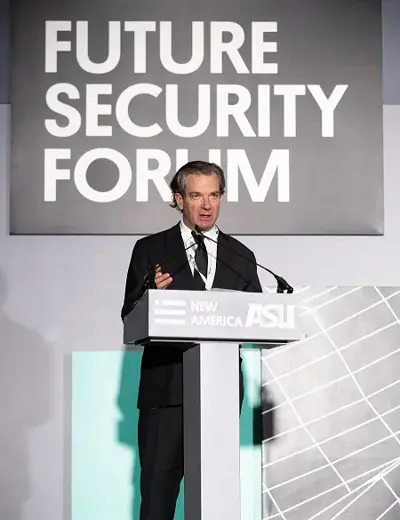
Peter Bergen is an American journalist, author, and producer who serves as CNN's national security analyst, New America's vice president, and as a professor of practice at Arizona State University. He produced the first television interview with Osama bin Laden in 1997. The interview, which aired on CNN, was the first time that bin Laden was interviewed by Western media.
