Edmund S. Muskie Quotes
... in these elections of 1970, something has gone wrong. There has been name-calling and deception of almost unprecedented volume. Honorable men have been slandered. Faithful servants of the country have had their motives questioned and their patriotism doubted.... The danger from this assault is not that a few more Democrats might be defeated—the country can survive that. The true danger is that the American people will have been deprived of that public debate, that opportunity for fair judgment, which is the heartbeat of the democratic process. And that is something the country cannot afford.
Both President Nixon and Vice President Agnew attacked Democratic candidates' "creeping permissiveness" and labeled anti-war protesters as "thugs and hoodlums."
Edmund S. Muskie, 1914-1996, U. S. Secretary of State, U. S. Senator (Democrat, ME), 1972 Democratic nominee for President, Televised speech, November 2, 1970
Sourced by: Eigen's Political and Historical Quotations

Madison was right on most things, but got this one wrong. Of course he did not anticipate the era of mass communication which makes demagoguery in large areas possible.


The Republican Presidential Candidate in the Election of 2016, Donal;d Trump, when with only a few weeks to go before Election Day, and the polls indicated that he was substantially behind, began to give speeches that included many statements that the Election was rigged against him. See Quotation 643708 as an example. He presented no evidence at all, and even could not specify who was doing the rigging or how they were doing it. However, many of his followers, who tend to believe many political conspiracy theories, started to make plans for continual action after the election if Trump[ loses. For some unstable followers—all candidates for President have some—they were already planning methods of resisting if Hillary Clinton should win. To make matters worse Trump had encouraged his supporters to take extra legal action to prevent Hillary Clinton from destroying the country as they ave known it. He also announced that he would not necessarily accept the election results if Clinton won. He even threatened to have her jailed when he won the Presidency. Chertoff, a fellow Republican, was very familiar with unstable people and their oft times dangerous behavior to “protect” them, their family and the nation from some conspiracy or another. Chertoff and many other Republican leaders tried to persuade Clinton to refrain from such demography, but Trump was one of those people who tended not to listen to advisors or colleagues. He continued on his dangerous rhetorical path.


The Republican Presidential Candidate in the Election of 2016, Donal;d Trump, when with only a few weeks to go before Election Day, and the polls indicated that he was substantially behind, began to give speeches like this one that included many statements that the Election was rigged against him. He presented no evidence at all, and even could not specify who was doing the rigging or how they were doing it. However, many of his followers, who tend to believe many political conspiracy theories, started to make plans for continual action after the election if Trump[ loses. For some unstable followers—all candidates for President have some—they were already planning methods of resisting if Hillary Clinton should win. To make matters worse Trump had encouraged his supporters to take extra legal action to prevent Hillary Clinton from destroying the country as they ave known it. He also announced that he would not necessarily accept the election results if Clinton won. He even threatened to have her jailed when he won the Presidency. Chertoff, a fellow Republican, was very familiar with unstable people and their oft times dangerous behavior to “protect” them, their family and the nation from some conspiracy or another. Chertoff (See Quotation 643701) and many other Republican leaders tried to persuade Clinton to refrain from such demography, but Trump was one of those people who tended not to listen to advisors or colleagues. He continued on his dangerous rhetorical path.

Zt the time he made this statement, some Russians—probably with the blessing of the Russian government—had been hacking the e-mail computers of the Democratic National Committee and making embarrassing e-mails public through Wikileaks. Many Americans were concerned at the possibility that Russia, another nation, or a non-state group could hack into the voting machines and the computers that tally the votes. This statement was made to reassure them. There are 9000 different polling places where Americans can vote in a Presidential election. There is no single entity that anyone could hack to rig the vote counts. And there is no uniformity in the voting machines used, the tabulating and aggregating methods and machines, and the software that is used to tally the vote in cities, counties and states. And no voting machines are connected to the Internet.


They were voting on ignoring the fraudulent vote count in Dallas County, Alabama. The counter argument was that it would disenfranchise those honest voters of the country whose votes would not then be counted.
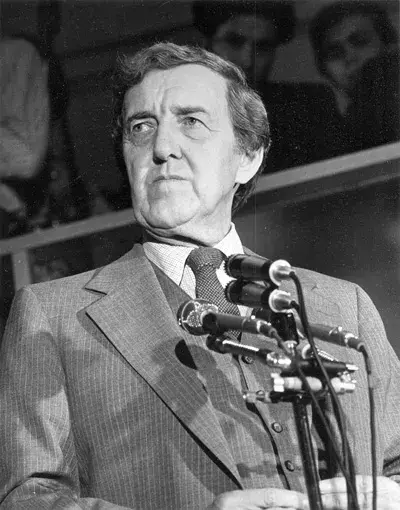
Edmund Sixtus Muskie was an American statesman and political leader who served as the 58th United States Secretary of State under President Jimmy Carter, a United States Senator from Maine from 1959 to 1980, the 64th Governor of Maine from 1955 to 1959, and a member of the Maine House of Representatives from 1946 to 1951. He was the Democratic Party's candidate for Vice President of the United States in the 1968 presidential election, alongside Hubert Humphrey.
