Joseph Stalin Quotes
In the Soviet army it takes more courage to retreat than advance.
Harriman, W. Averell, and Elie Abel. Special Envoy to Churchill and Stalin, 1941-1946. Random House, 1975, p. 277.


As an educational and military leader, he saw the importance of each in a nation’s welfare.


Attila the Hun. If countries formed alliances against him, he took it as a sign of weakness and allies were cowards because they were afraid to fight alone.
Attila the Hun. The Romans aided by Theodoric, King of the Visigoths, fought the Huns in the only battle that Attila ever lost which he lost badly. There were 165,000 men killed in an afternoon. The Roman General, Flavius Aetius, had been a boyhood friend of Attila’s and had fought with him against the Visigoths. The Romans had Attila trapped but his old friend let him escape with just a good thrashing to his ego and army as to not upset the balance of power and tilt it in favor of the Goths. Roman foreign policy at the time was to keep all the Barbarians strong enough to fight one another so that none would be dominant but all weaker than Rome. Divide and conquer.

This was an incredible order not allowing any Russian Army unit to retreat or surrender. However, it worked. The Russians, with American help of arms, held off the mighty German invading Army. However the German invasion cost the Russians a staggering 22 million lives, mostly civillian.


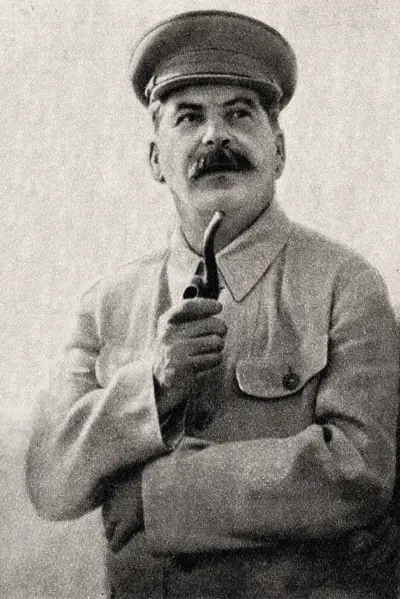
Joseph Vissarionovich Stalin was a Georgian revolutionary and the ruler of the Soviet Union from 1927 until 1953. He served as both General Secretary of the Communist Party of the Soviet Union (1922–1952) and Chairman of the Council of Ministers of the Soviet Union (1941–1953). Despite initially governing the country as part of a collective leadership, he ultimately consolidated power to become the Soviet Union's de facto dictator by the 1930s. A communist ideologically committed to the Leninist interpretation of Marxism, Stalin formalized these ideas as Marxism–Leninism while his own policies are known as Stalinism.
