Jean-Paul Sartre Quotes
In the France of today, the only class with a doctrine is the working class…. The only one … safeguarding the democratic institutions.
Jean-Paul Sartre, 1905-1980, French Philosopher, Quoted in Donald Sassoon, One Hundred Years of Socialism, 1996
Sourced by: Eigen's Political and Historical Quotations


Ironically, this view was also held by many of the capitalist “Captains of American Industry” who believed that all unions were revolutionist regardless of the views of the union’s membership or leadership. Even today, there are some who still equate trade unionism with communism and revolution. The majority of the unions and the left never believed that, but the extreme communists and extreme capitalists did than and some do today.


Vladimir Lenin

This was a great victory for the Victor Berger wing of the party. They purged the violence advocates and communists from the party. Despite this, a few right wingers call any socialist a communist and a revolutionary.

Big Bill Haywood. Historically, the upper economic and business class, including currently, tend to view all labor organizations and unions as socialistic and or communistic and attach them for being such. However, in many industries in America today labor has a great deal of power and the industries are not socialistic or communist. The IWW however was one of the labor organizations that was based on socialism and contained many communists over the years. Haywood himself was a leader of the Socialist Party and campaigned for Eugene Debbs. Like Debbs he was convicted of an unconstitutional law of speaking against the WWI draft. Unlike Debbs who went to prison and was released later, Haywood skipped bail and lived in Russia for the rest of his life.
Vladimir Lenin


The first quotation was made shortly after the launching of The Clarion in 1891. The newspaper was relatively successful but while England moved more to the left, socialism was not embraced by Englishmen. Later, Blachford concluded that the conversion would not likely take place soon.


There were massive strikes in Italy. These strikes began in the engineering factories and soon spread to railways, road transport, and other industries. The strikers, however, did more than just occupy their workplaces, they seized them for themselves. Soon 500,000 strikers were at work, producing for themselves. The question was what next. Malatesta and others recommended that they go on and take over the government and not just try and have better labor conditions and factory operations. See {616350}. He warned that the capitalists and middle class bourgeoisie had been so frightened by the successful national strike that they would even ally with the Fascists who they did not like either. That is how Mussolini and his Fascists came to power.

Ironically, it was a German democracy that later elected Adolf Hitler.


He had squads of thugs that he would “rent” out to other gangsters for their enforcement activities and to unions to protect themselves from goons and intimidate non union workers. However, he would not let his men work as goons and strike busters or for companies—despite huge pay offers—to keep their workers in line, a common practice at the time.


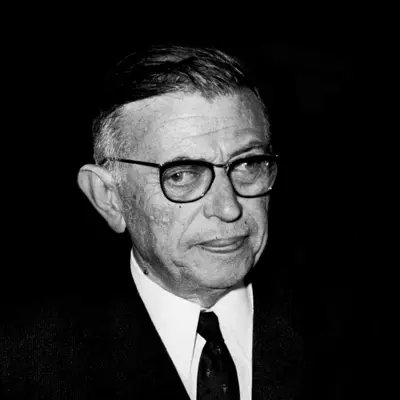
Jean-Paul Charles Aymard Sartre was a French philosopher, playwright, novelist, screenwriter, political activist, biographer, and literary critic. He was one of the key figures in the philosophy of existentialism and phenomenology, and one of the leading figures in 20th-century French philosophy and Marxism. His work has also influenced sociology, critical theory, post-colonial theory, and literary studies, and continues to influence these disciplines.
