V. S. Naipaul Quotes
In the beginning, before the arrival of the white men, I had considered myself neutral. I had wanted neither side to win, neither the army nor the rebels. As it turned out, both sides lost.
Naipaul, V. S. A Bend in the River. Andre Deutsch, 1979, p. 14.


This observation was made when Commander-in-Chief for the 13 American Colonies, General Edward Braddock had organized a military expedition to destroy some of the forts that the French had constructed. (See {37008}.) Braddock and the other military officers thought that the force Braddock had organized what he thought would be overwhelming force that could easily accomplish the objective. But unfortunately for Braddock, Franklin was prescient, See {583428}.


She had been asked what she had hoped to accomplish be killing Marat. Of all people Marat had been the most active and vigorous in calling for the beheading of thousands in the French Revolution. It was known as the Reign of Terror.


The Kaiser, facing a revolution, instructed Groener to use the army to put down the revolution. The Kaiser had to abdicate and the German Republic was born, soon to fall to the Nazis.


The Russians did come shortly thereafter in 2000. They captured Salman Raduyev, who regretted his challenge.


Conant, a great scientist in his own right, had the confidence of the political, academic, and industrial establishment and was appointed to the Committee that was to set policy for the Manhattan Project representing President Roosevelt. Germany had been the world leader in Physics before the war. American leaders and scientists were certain that we were in a scientific race with the Germans. Even after Germany had been defeated, President Truman was told that we had beaten the Germans in the race for the bomb. Actually, although almost no one in the US government realized it then, the Germans had NO PROGRAM of nuclear weapons development at all. Hitler did not trust the Theoretical Physics and Theory of Relativity because Einstein and other Jewish scientists had been instrumental in its development. He derogatorily referred to it as “Jewish Science”. Germany bet its scientific efforts on the V2 Rockets and the Jet Airplane, both of which they were successful with but too late to have any material effect on the war. Ironically, even after most of the great German physicists were run out of Germany, there were still two of the greatest who may well have been capable of nuclear weapons development. But neither Werner Heisenberg or Otto Hahn were inclined to engage in that kind of research, and neither of them were even asked whether or not they thought it was possible. The anti-Semitic Nazis just assumed that it could not be. Truman and his associates did not find out for another year or more that there was no race. There was one OSS spy, Moe Berg, who had actually talked to Heisenberg in the midst of the war, and concluded that he not only was not working on an atomic bomb, but was not up on the latest pre-war critical research needed to develop a bomb. Hahn knew and had created the first chain reaction for which he later won the Nobel prize but he was a chemist and didn’t really understand the Physics and mathematics involved in making a weapon and was a confirmed pacifist. Ironically, his colleague, Lise Meitner who had done the physics and mathematics on that experiment was Jewish and had to flee Germany. In Denmark she gave the results to Niels Bohr, who shared them with Leo Slizard and Einstein when Bohr came to the United State and that initiated the famous letter that was sent to FDR which triggered the Manhattan Project. The German first nuclear reaction was used by the Americans because the politicians listened to the scientists, while in Germany, the politicians gave no credence to their scientists and their experiments in nuclear fission.


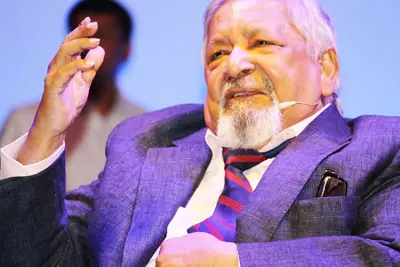
Sir Vidiadhar Surajprasad Naipaul TC, commonly known as V. S. Naipaul, and familiarly, Vidia Naipaul, was a Trinidad and Tobago-born British writer of works of fiction and nonfiction in English. He is known for his comic early novels set in Trinidad, his bleaker novels of alienation in the wider world, and his vigilant chronicles of life and travels. He wrote in prose that was widely admired, but his views sometimes aroused controversy. He published more than thirty books over fifty years.
