Alan Watts Quotes
In other words, a person who is fanatic in matters of religion, and clings to certain ideas about the nature of God and the universe, becomes a person who has no faith at all.
Watts, Alan. The Wisdom of Insecurity. Pantheon Books, 1951, p. 24.


The Torah comprises the first 5 books of the Bible (Old Testament). The Arab countries of the Middle East are not alone in having to content with ultra-religious clerics who want to control the government and use it to impose religious law on the entire population. Israel also has the problem. In the Arab countries to deny being religion is to put yourself in danger including risking your life. So no one really knows what proportion of the population supports the religious imposition from the government. In Israel, however, this is easily determined by polls. The majority of Israelis are secular Jews. Of the religious Jews, the majority of them believe in extensive separation between the state and the religion. But there is a minority of ultra-orthodox which would have Israel to be a Theocracy. They are a minority but they are politically very strong. They receive large financial support from extremely wealthy Americans, have religious political parties, are extremely passionate advocates, and are willing to devote huge amounts of time to make Israel a more religious state and ideally a theocracy. Ironically, there is a great religious and philosophical similarity between the extremist Jews of Israel and the extremists Muslims in many of the Arab nations. They both want a theocracy. The only difference is which religion should the Theocracy represent.

This statement is eerily similar to the statements of some of the Islamic fanatic fundamentalists 80 years later.


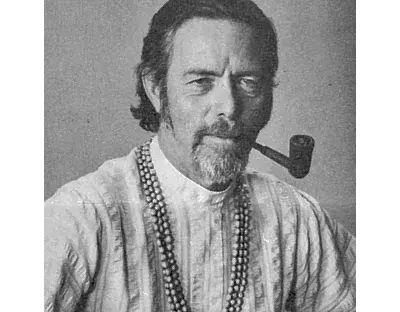
Alan Wilson Watts was a British philosopher, writer and speaker known for interpreting and popularising Buddhism, Taoism, and Hinduism for a Western audience. Born in Chislehurst, England, he moved to the United States in 1938 and began Zen training in New York. He received a master's degree in theology from Seabury-Western Theological Seminary and became an Episcopal priest in 1945. He left the ministry in 1950 and moved to California, where he joined the faculty of the American Academy of Asian Studies.
