Hermann Hesse Quotes
In Germany I have been acknowledged again since the fall of Hitler, but my works, partly suppressed by the Nazis and partly destroyed by the war; have not yet been republished there.
Hesse, Hermann. "Autobiography." Nobel Lectures, Literature 1901-1967, edited by Horst Frenz, Elsevier Publishing Company, 1969.


The Nazis occupied the cities, but the partisans survived in the mountains. The resistance was ferocious and very effective. From a German Soldier’s point of view, the Yugoslav front was the most dangerous assignment where his odds of being killed was even greater than the Russian front.


This was the first day of WWII and Hitler’s armies seemed invincible. Kaplan was one of the few who at that time predicted allied victory. He was not even wrong about his own fate. He and the vast majority of the Jews in the Warsaw ghetto never survived.

Frau Wagner was one of several agents of Nazi Germany sent to the United States to develop good will for Germany and funds for Hitler. Anti-German feeling was still high from the First World War but America had its share of right wingers like Ford. Hitler and Ford were mutual admirers. See {586988} for Hitler’s view of Ford.


He defeated Adolf Hitler at the polls in 1932, but the next year he was compelled to yield to Nazi power and appointed Hitler Chancellor of Germany.

The Prime Minister, Neville Chamberlain, preceded him with the announcement of declaration of war against Germany, but it was left up to the Foreign Minister to explain the implications. This was the first time in history that a nation had used radio to communicate such momentous events to its population.

The man who was “the best war photographer in the world” but was a refugee from Hungary in New York. The Government actually prohibited him from having a camera and would not give him a visa to go to Europe to cover the War. Finally the government relented from its absurd concept of security and Capa became the leading photographer of the American Army effort in Europe and shot the greatest photos of the D-Day landing. Incredibly, in the McCarthy era, his passport was rescinded by the State Department because he had photographed the Spanish Civil War and was wrongly thought a communist. After legal action he got his passport back and covered Vietnam. While with front-line American troops he was blown up by a mine, the first American journalist killed in the Vietnam war. And the man who the State Department thought disloyal in three wars, was given a military funeral in Vietnam and his family was offered burial in Arlington National Cemetery reserved for American military.

The historical record that is available shows that while the Pope did not, actively or aggressively oppose Hitler, and he did not discipline Catholic prelates who were Nazi supporters, there is no specific evidence that shows the Pope conspired with Hitler, about the extermination of Jews or anything else. However, most of the relevant documents of the era are in the Vatican and the records have been sealed and have not been visible to historians. Apologists for the Pope’s passivity point out that a large percentage of Germans were Catholic and he had a duty to not antagonize Hitler who would retaliate against German Catholics and the German Catholic clergy and church property. Further, Fascist Italy was under Hitler’s control, and the Vatican itself could have closed and its property seized. The historical record is still very vague.

When the doubts began to be expressed, the scientists were briefed on the planned invasion of the Japanese mainland and the military medical preparations for treating and caring for ½ million serious wounded casualties. In addition, given the state of war, there was expected about the same number of American Military deaths. On top of that, there would be many more Japanese military casualties plus even more Japanese civilian deaths and wounded. The use of the Atom Bomb would save all those lives but have casualties of its own, but far fewer. At the time, surprising to most people now, the use of the atomic bomb was not an issue of controversy at all. There were no Congressman who questioned it, no newspapers which editorialized against the use of the bomb. There were not even any other counties which protested its use.
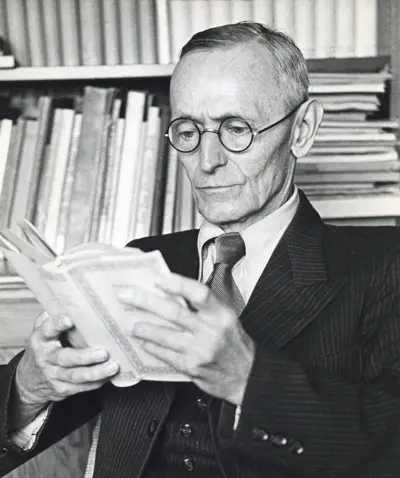
Hermann Karl Hesse was a German-born Swiss poet, novelist, and painter. His best-known works include Demian, Steppenwolf, Siddhartha, and The Glass Bead Game, each of which explores an individual's search for authenticity, self-knowledge and spirituality. In 1946, he received the Nobel Prize in Literature.
