Sallust Quotes
In battle it is the cowards who run the most risk; bravery is a rampart of defense.
Sallust. The Conspiracy of Catiline. Translated by J. C. Rolfe, Loeb Classical Library, Harvard University Press, 1921, p. 121.


He drove the British into the sea when no one expected that outcome.

Attila the Hun. The Romans aided by Theodoric, King of the Visigoths, fought the Huns in the only battle that Attila ever lost which he lost badly. There were 165,000 men killed in an afternoon. The Roman General, Flavius Aetius, had been a boyhood friend of Attila’s and had fought with him against the Visigoths. The Romans had Attila trapped but his old friend let him escape with just a good thrashing to his ego and army as to not upset the balance of power and tilt it in favor of the Goths. Roman foreign policy at the time was to keep all the Barbarians strong enough to fight one another so that none would be dominant but all weaker than Rome. Divide and conquer.

Attila the Hun. If countries formed alliances against him, he took it as a sign of weakness and allies were cowards because they were afraid to fight alone.


This is not the most common view military view which tends to place the senior officers out of harm’s way as they are “too valuable” to become casualties. Among modern armies, Israel stands out as having the same leadership doctrine as Genghis Khan. Those who attack Israel and lose, never have their commanders at the front of the battle. Israel does.

Lacedaemonian refers to the ancient Greek city of Sparta,

In general, Jefferson thought Blacks at that stage of their development inferior to whites but as this quotation shows he also thought them superior in certain traits. He also stated that their memories were superior to that of whites, but this observation we know now is not, like any of the others, a racial characteristic but is common in all oral cultures where human memory is the only way of preserving history, literature, procedures and much culture.


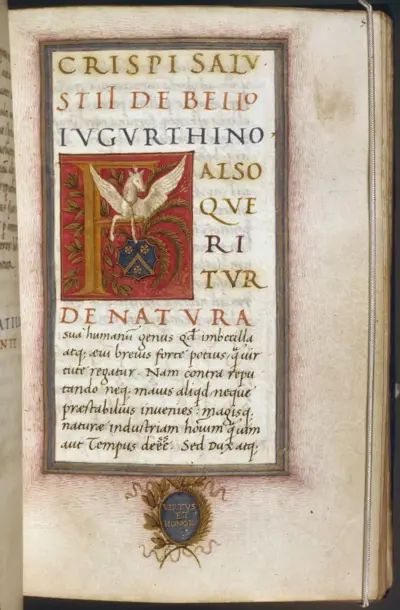
Gaius Sallustius Crispus, usually anglicised as Sallust (/ˈsæləst/; 86 – c. 35 BC), was a Roman historian and politician from an Italian plebeian family. Sallust was born at Amiternum in the country of the Sabines and was a popularis, an opponent of the old Roman aristocracy, throughout his career, and later a partisan of Julius Caesar. Sallust is the earliest known Latin-language Roman historian with surviving works to his name, of which Catiline's War (about the conspiracy in 63 BC of L. Sergius Catilina), The Jugurthine War (about Rome's war against the Numidian King Jugurtha from 111 to 105 BC), and the Histories (of which only fragments survive) are still extant. Sallust was primarily influenced by the Greek historian Thucydides and amassed great (and ill-gotten) wealth from his governorship of Africa.
