Hippocrates Quotes
In acute diseases the physician must conduct his inquiries in the following way. First he must examine the face of the patient, and see whether it is like the faces of healthy people, and especially whether it is like its usual self. Such likeness will be the best sign, and the greatest unlikeness will be the most dangerous sign. The latter will be as follows. Nose sharp, eyes hollow, temples sunken, ears cold and contracted with their lobes turned outwards, the skin about the face hard and tense and parched, the colour of the face as a whole being yellow or black.
Hippocrates. "Prognostic." Hippocrates, vol. 2, translated by W. H. S. Jones, Harvard University Press, 1923, p. 9.


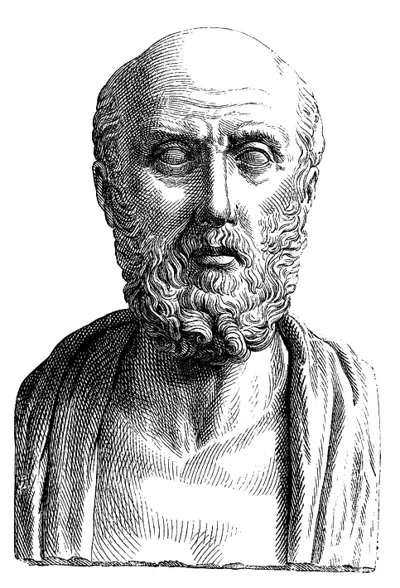
Hippocrates of Kos (/hɪˈpɒkrətiːz/; Greek: Ἱπποκράτης ὁ Κῷος, translit. Hippokrátēs ho Kṓos; c. 460 – c. 370 BC), also known as Hippocrates II, was a Greek physician of the Age of Pericles (Classical Greece), who is considered one of the most outstanding figures in the history of medicine. He is traditionally referred to as the "Father of Medicine" in recognition of his lasting contributions to the field, such as the use of prognosis and clinical observation, the systematic categorization of diseases, or the formulation of humoural theory. The Hippocratic school of medicine revolutionized ancient Greek medicine, establishing it as a discipline distinct from other fields with which it had traditionally been associated (theurgy and philosophy), thus establishing medicine as a profession.
