Mikhail Gorbachev Quotes
[In a nuclear era:] It is necessary for all [nations] to feel they are equally secure.
Mikhail Gorbachev, Russian President, Quoted in Sherr, The Other Side Of Arms Control, 1988
Sourced by: Eigen's Political and Historical Quotations


This was his last publication. He died of a heart attack as the magazine was being printed. Since this was written one other possible use of nuclear weapons has been suggested—namely, retaliation for a biological attack. From a policy point of view, maintaining an arsenal of biological weapons for retaliatory purposes is dangerous and use for retaliation of biological weapons is not very controllable and arguably less humane than a nuclear weapon. His point however still holds. We have to have a national defense policy against many threats and we have to have defense policies that handle all these without nuclear tactics is insufficient to handle any of the threats without causing more problems and we have other weapons and techniques that are just as, if not more, effective. They and systems under development have the major role in our current defense policy.

Many politicians and military thinkers disagree with Kraus. America, England, France, Russia, and Israel have all demonstrated over the years that even with great provocation they would not resort to nuclear retaliation nor have they ever threatened use of WMDs. Iran, in contrast, has repeatedly stated as one of their major objective, the total destruction of another UN member state—Israel. Further, Iran has never possessed a weapon that it did not use shortly after possession, including poison gas. Therefore America and the United Nations have all determined that a double standard is necessary with Iran.


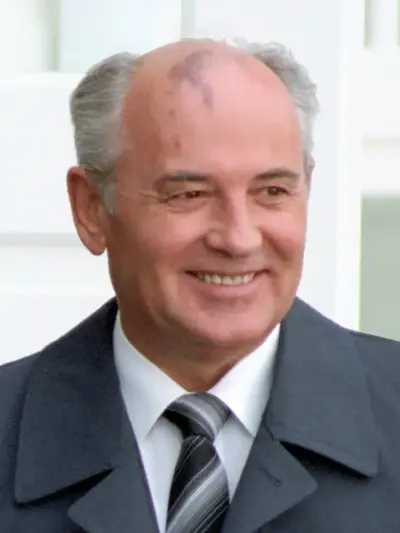
Mikhail Sergeyevich Gorbachev is a Russian and former Soviet politician. The eighth and last leader of the Soviet Union, he was the General Secretary of the Communist Party of the Soviet Union from 1985 until 1991. He was also the country's head of state from 1988 until 1991, serving as the chairman of the Presidium of the Supreme Soviet from 1988 to 1989, chairman of the Supreme Soviet from 1989 to 1990, and president of the Soviet Union from 1990 to 1991. Ideologically, Gorbachev initially adhered to Marxism–Leninism, although he had moved towards social democracy by the early 1990s.
