Milton Friedman Quotes
In a free-enterprise, private-property system, a corporate executive is an employee of the owners of the business. He has direct responsibility to his employers. That responsibility is to conduct the business in accordance with their desires, which generally will be to make as much money as possible while conforming to their basic rules of the society, both those embodied in law and those embodied in ethical custom... .
Whether blameworthy or not, the use of the cloak of social responsibility, and the nonsense spoken in its name by influential and prestigious businessmen, does clearly harm the foundations of a free society. I have been impressed time and again by the schizophrenic character of many businessmen. They are capable of being extremely far-sighted and clear-headed in matters that are internal to their businesses. They are incredibly short-sighted and muddle-headed in matters that are outside their businesses but affect the possible survival of business in general. This short-sightedness is strikingly exemplified in the calls from many businessmen for wage and price guidelines or controls or income policies. There is nothing that could do more in a brief period to destroy a market system and replace it by a centrally controlled system than effective governmental control of prices and wages.
The short-sightedness is also exemplified in speeches by businessmen on social responsibility. This may gain them kudos in the short run. But it helps to strengthen the already too prevalent view that the pursuit of profits is wicked and immoral and must be curbed and controlled by external forces. Once this view is adopted, the external forces that curb the market will not be the social consciences, however highly developed, of the pontificating executives; it will be the iron fist of Government bureaucrats. Here, as with price and wage controls, businessmen seem to me to reveal a suicidal impulse.
Milton Friedman in his book Capitalism and Freedom, University of Chicago Press, 1962


At the time, Ambani was the richest man in India. Almost all of the great business developers have objectives far more than making money.


March 4, 1933 was the date that Franklin Delano Roosevelt had assumed the Presidency from Herbert Hoover and used government to combat the Great Depression whereas Hoover would not take any of these steps as the conservative wing of his party and he regarded anything that government did was “creeping socialism”. Historically, it is useful to recall what steps Roosevelt took that were described as socialism. These include Social Security, Federal Deposit Insurance for bank accounts, aid to farmers, the Civilian Conservation Corps, Regulation of the stock market, regulation of banks and many other things that are key elements of modern capitalism which virtually every capitalistic nations has in one form or another. Long after Truman was out of office, the most conservative elements of the Republican Party have accused every Democratic President of “creeping socialism” when they were actually quite opposed to socialism. Even when their career before their presidency was full of criticisms of socialism and policies that are opposite, as in the case of President Obama, the President has been accused of being a socialist. However, it started with Franklin Delano Roosevelt and Harry S Truman.

This is the definition of good business that most conservative a business interests prefer. They do not wish to differentiate among the businesses nor do they wish to imply that businesses have any other obligations or desirable characteristics. By this definition, a business that makes money producing adult pornography is as good as one that develops pharmaceuticals; one that creates well paying jobs is as good as one that creates minimum wage jobs or even exports jobs overseas. Complying with the law in a democracy has never been a definition of good citizenship. It is a minimum duty to which all are obliged some businesses enhance the quality of life; others diminish it. This is where many differ with Mr. Longworth.


During The Depression although business in general was doing very poorly, there were a few which had grown immensely powerful and abused the power as there was little or no regulation at the time.


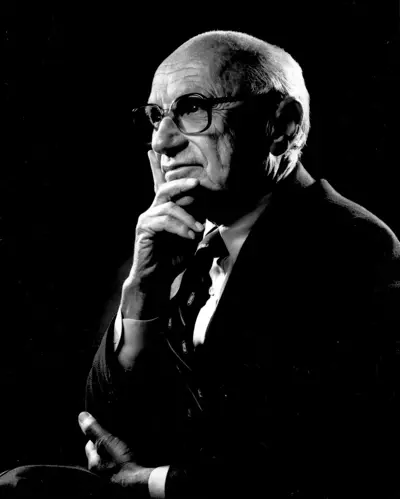
Milton Friedman was an American economist and statistician who received the 1976 Nobel Memorial Prize in Economic Sciences for his research on consumption analysis, monetary history and theory and the complexity of stabilization policy. With George Stigler and others, Friedman was among the intellectual leaders of the Chicago school of economics, a neoclassical school of economic thought associated with the work of the faculty at the University of Chicago that rejected Keynesianism in favor of monetarism until the mid-1970s, when it turned to new classical macroeconomics heavily based on the concept of rational expectations. Several students and young professors who were recruited or mentored by Friedman at Chicago went on to become leading economists, including Gary Becker, Robert Fogel, Thomas Sowell and Robert Lucas Jr.
