Ella Baker Quotes
I'm sure, out of the context here of Stanley Levison's relationship with the Jewish liberal forces, that had made contributions. I remember one such contribution before they moved from Montgomery. An associate in the real estate business with Stanley had lost a son in the war, and she wanted to do something in memory of him. So, she made available certain monies to be used by the emerging leadership there in Montgomery. I'm sure other individuals did.
Baker, Ella. Interview by John Britton. 19 June 1968. Civil Rights Documentation Project, Moorland-Spingarn Research Center, Howard University.


She and many of the other white activists were called “do-gooders” by the Southern authorities of communities which were integration demonstration targets. The term was derogatory in the South, but Mrs. Peabody and others were proud of the term as that was exactly their purpose—to do good. Mrs. Peabody, and the wives of a number of wives of Christian Bishops, black and white, went to a restaurant in St. Augustine and requested service which was contrary to the segregation laws of Florida at the time. The women were arrested. The act of civil disobedience in integrating the restaurant was one act of a planned desegregation strategy worked out with Martin Luther King’s SCLC organization. The mature age of the women and their prominent husbands brought a great deal of newspaper coverage which is just what the demonstrators wanted. The photo is of Mrs. Peabody getting arrested. See {637404} and {637405} for more on this incident.
At that time the law prohibited Negroes from sitting anywhere in a public bus except the rear. Blacks, if there were not enough rear seats had to stand in the back even if there were many vacant seats in the “white section” of the bus. This was typical of the racial discrimination that existed at that time. That is what all the civil rights demonstrations and boycotts of that era was all about—eliminating government discrimination against Blacks. The Federal Courts including the Supreme Court ruled that the bus segregation was unconstitutional, and the awful practice ended in Montgomery.
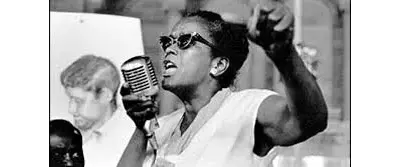
Ella Josephine Baker was an African-American civil rights and human rights activist. She was a largely behind-the-scenes organizer whose career spanned more than five decades. In New York City and the South, she worked alongside some of the most noted civil rights leaders of the 20th century, including W. E. B. Du Bois, Thurgood Marshall, A. Philip Randolph, and Martin Luther King Jr. She also mentored many emerging activists, such as Diane Nash, Stokely Carmichael, Rosa Parks, and Bob Moses, whom she first mentored as leaders in the Student Nonviolent Coordinating Committee (SNCC).
