Charles B. Rangel Quotes
I'm in the kitchen and I'm not walking out.
Rangel, Charles B. "Remarks on the House Floor." Congressional Record, Government Publishing Office, 10 Aug. 2010.


She had asked Woodward when all the details about Richard Nixon and Watergate would finally be known. Woodward replied, “Never.”


Barstow the Democratic Governor who had no serious opposition in 1853 found himself challenged for reelection by Coles Bashford of the new Republican Party. The Board of Canvassers reported that Governor Barstow had won reelection but by less than 200 votes in the whole state. The Republicans charged that there had been fraud in some of the rural districts and petitioned the Wisconsin Supreme Court which ruled that nonexistent precincts had indeed voted for the Governor. Barstow however refused to recognize the decisions of the court claiming that the court had no jurisdiction over the Board of Canvassers who were part of the executive branch. The Republicans held their own inauguration and two men claimed to be Governor. But the Governor claimed that the state constitution did not give the court any authority to deal with the crisis, He even called out the State Militia to maintain his office and intimidate the Supreme Court and keep the “other governor” from the state house. Nonetheless the court ruled that even the Governor had to obey the law and the Supreme Court would determine what the law was. Barstow finally “resigned.” See {587915} & {587917}.

He was arrested and jailed. However, often the coups leaders give the president the choice of either resigning or committing suicide if they do not murder him directly.

Conant was also one of America’s premier scientists why had served on all the government policy committees about the atomic bomb development and use. He was the only scientist who had the respect of the greatest of the scientists and also was a respected government administrator with the confidence of the politicians. The “super” was the name then for the Hydrogen Bomb, a logical next step that could be taken according to the laws of physics. However J. Robert Oppenheimer and the Atomic Energy Commission General Advisory Committee he was chairing voted unanimously to NOT develop the Hydrogen Bomb at the time. The feeling was that if we did, the Russians would feel that they too would have to also, and their physicists were estimated to be easily capable of doing it. They thought that we could easily build more atom bombs—enough to wipe out Russian civilization if they attempted to use any of the atomic weapons they had built. The Chairman of the AEC and some other civilian officials who did not really understand the science but were they thought knowledgeable about international power politics, wanted to go ahead and build the “super” which Edward Teller had recommended and led the very few scientists on that side of the issue. The civilian hawks’ logic was that the Russians were so inferior to the United States that they could not have developed their atomic capability without having the information from their spies who had penetrated out program. If we built a supply of hydrogen weapons, they argued, the Russians could never gain parity if we maintained proper secrecy. They were not good enough scientists. Therefore we would dominate the world and could contain communism. Conant and most other American scientists knew that the Russians could develop supers and then we would be in a scientific arms race which in all probability we would not win every stage. Better they thought to have a stand off. However, the AEC Chairman started a campaign to destroy Oppenheimer’s credibility with the public as he was the public face of American Physics. The scientists lost the worst fight in American history between politicians and scientists. Conant, himself was appointed to literally be the peacetime ruler of West Germany and had a brilliant success there, but he was unable to stop the super development after Oppenheimer had been publicly castigated as a security leak. The Russians then developed their hydrogen weapons and the arms race continued throughout the Cold War as most of the scientists thought it would.


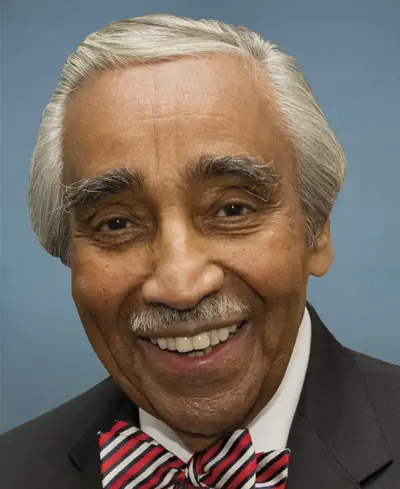
Charles Bernard Rangel is an American politician who was a U.S. representative for districts in New York from 1971 to 2017. A member of the Democratic Party, he was the second-longest serving incumbent member of the House of Representatives at the time of his retirement, serving continuously since 1971. As its most senior member, he was also the Dean of New York's congressional delegation. Rangel was the first African-American Chair of the influential House Ways and Means Committee. He is also a founding member of the Congressional Black Caucus.
