Maria Ressa Quotes
I'm banking on the fact that there are still good people in government who will prevent this. I've been a journalist for more than 33 years, and at Rappler we refuse to change, I refuse to be bullied.
Ressa, Maria. "Maria Ressa speaks out after arrest." Rappler, Rappler Inc., 14 Feb. 2019.


“Magistrate” historically has had a political meaning of the chief executive of a political entity. Mayors are still referred to as the “Chief Magistrate of the city.” The President is sometimes referred to as the “Chief Magistrate.” Lower magistrates can be political appointees who have power and responsibility for governing as well as judges of courts to whom the term “magistrate” refers in most modern references. The older use of the term harkens back to a time when there was no separation of powers and the assembly was the legislative, executive and judicial powers all at the same time.

There has been a constant conflict between the government and the press regarding the right of a journalist to refuse to disclose his/her sources for a story or to reveal his/her notes or outtakes. Reporters would sometimes be subpoenaed and if they refused to testify or disclose the subpoenaed information, they could be held in contempt of court and fined, jailed or both. However, one of the major reasons reporters have been able to get information on the malfeasance and incompetence of government is that leakers and whistleblowers have been willing to provide information to the press is that they are confident that the press will not disclose the source. The courts have ruled that journalists have no special rights regarding subpoenas, so the outcome of the conflict depends on the political decision of the administration. For the 2nd Obama administration, this has his announcement that the Justice Department would not jail reporters who ignored subpoenas. However many proponents of a free press, do not want to depend on the decision of the Attorney General in office and want Congress to pass a Shield Law for journalists.


The statement was in protest to the Spanish arrest of a Syrian born journalist, Taysir Alluni, who had been accused of supporting Al-Quaeda cells in Spain by moving money to the cells. Alluni was well connected with Al-Quaeda as he had reported on them for some time and had personally interviewed Osama Bin Laden. Many believe that the cash was a cultural misinterpretation of the Muslim custom of sending cash as a wedding present which the Spanish authorities may have misinterpreted as financing of terrorism. Many believe that he is the victim of Anti-Islamic bias. While many legitimate news organizations are are troubled by this case, the Syrian protest is particularly ironic. In Syria there is not freedom of the press and any reporter can go to jail for offenses from insulting Islam to disparaging the Syrian government and its officials. There is no such thing as freedom of expression in Syria and there has not been since the Baathists gained control of the government.


Historically in America, the local governments have been the most corrupt. State government somewhat less so, and the Federal Government has statistically, given the number of employees, the lowest proportion of corrupt officials. Even in modern times, there are many local jurisdictions where bribes of building inspectors, zoning officials, health inspectors and police are still common. At the end of the 20th century, for example, every single Kentucky County Commissioners but one was indicted and convicted for accepting bribes and kickbacks. At the federal level, there is much moral corruption with Presidents and members of Congress taking "campaigh contributions" in exchange for access and the ability to influence and even write legislation. The members of Congress wrote the laws so activities that many peopke would see as corrupt was actually legal. Even when the campaign conributions were used to pay "salaries" to the relatives of the member of Congress or he/she added the money to his/her retirement fund.


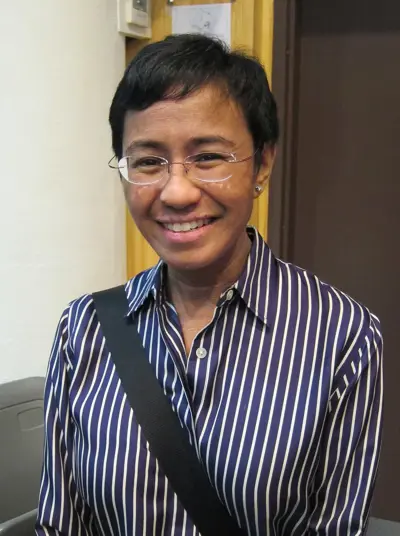
Maria Angelita Ressa is a Filipino-American journalist and author, the co-founder and CEO of Rappler. She previously spent nearly two decades working as a lead investigative reporter in Southeast Asia for CNN. In 2020, she was convicted of cyberlibel under the controversial Philippine Anti-Cybercrime law, a move condemned by human rights groups and journalists as an attack on press freedom.
