Ron Paul Quotes
If we had probably a repeal of most of the federal laws on drugs and the unfairness on how Blacks are treated with these drugs laws, it would be a tremendous improvement.
Ronald E. Paul, U.S. Congressman (Republican, TX), Libertarian Nominee for President, Your Legacy on Race[1], Republican Candidates "All-American Presidential Forum”, 2007
Sourced by: Eigen's Political and Historical Quotations


Two decades earlier leading Black politicians, observing the differential deleterious effects of drug use on Blacks called for a massive Federal effort to diminish substance abuse. The War on Drugs responded and reduced the drug use in America somewhat. However, the unintended consequences—especially for Blacks—caused many Black politicians to call for an end or serious curtailing to the War on Drugs. The differential effect on Black males was dramatic. White drug dealing tended to occur in private offices and homes where black dealing takes place to a greater extent on the streets where the lower level dealers are much more likely to be caught. The differential penal;ties for possession or selling of powdered cocaine (preferred by whites) and crack cocaine (preferred by Blacks) caused many more Blacks to be jailed. With less access to the better attornies, the Bplacks tend to get longer sentences, even for the same crime. In addition, the drug of choice for most whites is alcohol which was made legal while the drugs of choice for Blacks are illegal. In many Black urban neighborhoods like Newark, the majority of young Black men arwere in jail for ddrug law violations. See {624056} for a concurring opinion.


The vast majority of the million Blacks in prison have been sentenced for using or selling drugs.

Althought most of Seale’s “solutions” were counterproductive and/or ineffectual, and the Black Panthers were regarded as public enemies, Seale was right about some of his complaints including this one. In most of the South the changes forced by the Civil Rights and Voting Rights Acts where just beginning to have significant effect. So there were proportionately very few Blacks on Southern Juries. Even in the North, Blacks did not register to vote in proportion to their numbers so since jury pools were then usually drawn from voter registration lists, Blacks were statistically underrepresented. When a few Blacks were put on a jury panel, the prosecutor had the right of preemptory challenge as did the defense. But there were enough challenges so that the prosecutor could disqualify all the African Americans on the Jury. Even today, this is legal in many jurisdictions and although better than in 1970, then a Black defendant would rarely have African Americans on the jury of “his peers.”


Black protests and demonstrations were emerging throughout the country after a white police officer shot to death an unarmed black teenager in Ferguson, MO. This argument was made by a number of police apologist whites who could not understand the ferocity and passion of the demonstrations, but Giuliani was the most prominent politician taking that viewpoint. See {642521} for the refutation and response.

In the 1930s African Americans who traveled were subject to countless humiliations whenever the sought hotels, rooming houses, restaurants and other accommodations. Gas stations would not allow them to use bathrooms and they were reduced to using open fields. Traveling and vacationing was, for Blacks, humiliating. Wikipedia: “Green reviewed hotels and restaurants that did business with African Americans during the time of Jim Crow laws and racial segregation in the United States. He printed 15,000 copies each year. In the 1930s, Green began his work by compiling data on stores in the New York area that accepted black travelers, and published his first guide in 1936. Similar guides had been published for Jewish travelers, who sometimes faced discrimination. Green's guide was so popular that he immediately began to expand its coverage the next year to other US destinations, adding hotel and restaurants as well.”

This was a great surprise to most conservatives who assumed that Robertson, a major conservative leader and ordained minister would be opposed to drug legalization.


Instead of standing and saluting as professional athletes have done for decades before games, he kneeled and refused to stand. This caused great public criticism but also some initial support. He was potentially risking his multimillion dollar salary as this technically violated his contract to avoid anything embarrassing to the team. He also donated $1 million to programs in the area that were working to enhance Black/white understanding. Even those who disagreed with his choice of protest defended his right to do so, and after the initial furor, public opinion, while not in agreement about his method, tended to support him for having the courage of his convictions and using his celebrity for a worthy cause. After sensing the public opinion, his team matches his $1 donation. Professional athletes both in the NFL and in other sports then began to do the same as a form of protest for the large, disproportionate, number of black men who were killed, mostly when unarmed, by police. The reference to the “paid leave” was the practice followed by most police departments—usually required by collective bargaining agreements with police unions—of placing police officers accused of committing violations of laws or regulations on paid administrative leave while all the investigations, hearings, and other processes . While this practice protected the rights of those police officers who were not guilty, it ended up paying brutal murders for a some time entire their case was decided or acted upon be the district attorney.


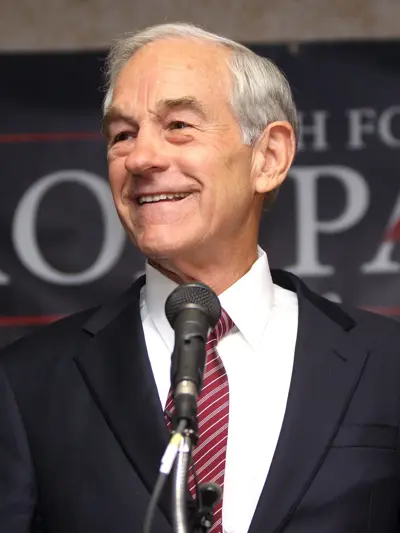
Ronald Ernest Paul is an American author, physician, and retired politician who served as the U.S. Representative for Texas's 22nd congressional district from 1976 to 1977 and again from 1979 to 1985, and for Texas's 14th congressional district from 1997 to 2013. On three occasions, he sought the presidency of the United States: as the Libertarian Party nominee in 1988 and as a candidate for the Republican Party in 2008 and 2012. A self-described constitutionalist, Paul is a critic of the federal government's fiscal policies, especially the existence of the Federal Reserve and the tax policy, as well as the military–industrial complex, the war on drugs, and the war on terror. He has also been a vocal critic of mass surveillance policies such as the USA PATRIOT Act and the NSA surveillance programs. He was the first chairman of the conservative PAC Citizens for a Sound Economy, a free-market group focused on limited government, and has been characterized as the "intellectual godfather" of the Tea Party movement, a fiscally conservative political movement that is largely against most matters of interventionism.
