Richard Brookhiser Quotes
If they wanted a Christian state, they could have done it. They were writing the rules. They could have put God in the rules.
Richard Brookhiser, Historian, Comment on the Founding Fathers intentions in writing the Constitution, Quoted in New York Times, February 27, 2005
Sourced by: Eigen's Political and Historical Quotations

This quotation is sometimes used to show that Washington thought religion important. Most of the founding fathers thought religion both important and potentially dangerous. They had observed Europe tear itself apart over religious differences. Note that Washington uses the words “religious principles” as opposed to “religion” or “religious prescriptions” or “religious doctrine.” The founders were not hostile to the concept of religion—even Jefferson and Franklin saw potential values in religion and religious institutions. They were hostile, however, to letting any particular sect dominate the religious environment of the nation. Nor did they want any of the religions controlling or operating the civil government. See {625616}.


This quotation is one of the first to make the critical observation that the only time that tolerance of a religion is necessary is when there is an established church and others that deviate from it. If there is no established church, as the Founding Fathers envisioned, there is no preeminent church to do the tolerating. All are equal. In practice, Protestant churches were proportionately dominant in early America and up through the 20th century. So most of the issue of tolerance problems in America were cultural. And there is still a minority of Christians who believe that America should be a Christian country and other religions should be “tolerated.” However, Clinton and most of the founders did not want to see even general Christianity established as the national religion even they it was the majority religion.

Opponents of the strict separation of church and state use this quotation to support their view. However, Story herein describes public sentiment, not what was passed and ratified in the Constitution and Bill of Rights. See {614309} and {614310} for his statements from the same work that show that there was no question in his mind but that church and state are separated by the Constitution and the First Amendment.


Her distorted historical view of the intentions of the Founding Fathers contradicts just about everything most said and wrote at the constitutional convention and otherwise. There was a small minority of very fundamentalist Christians who had an established church model in mind but most had observed the disasters in England and the rest of Europe brought by religion in government, and also had the problematic history of early American colonies with religion and politics. Also, at the time there were already over a dozen different substantial religions in the colonies as well as a number of non-religious and dissenter colonists. Even though there was no established church or any of the aspects of religion in government as Ms. Harris prefers written in the original constitution, the American people wanted to be so sure of that separation that they required the First Amendment in order to obtain ratification. On the other hand Ms. Harris had one strong aspect to her argument. She knew what God wanted, while her opponents and most Americans did not have that insight.


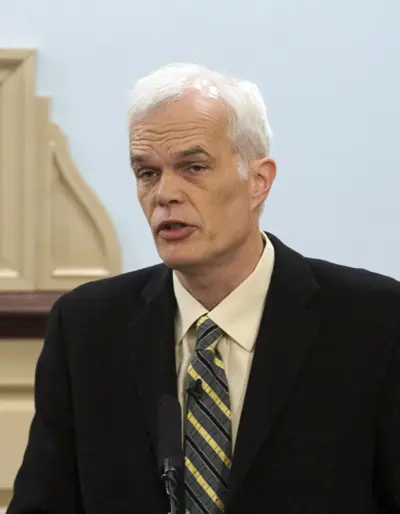
- Born: July 23, 1955
- Nationality:
- Profession: Journalist, Author, Editor, Historian
Richard Brookhiser is an American journalist, biographer and historian. He is a senior editor at National Review. He is most widely known for a series of biographies of America's founders, including Alexander Hamilton, Gouverneur Morris, and George Washington.
