Dwight D. Eisenhower Quotes
If the United Nations once admits that international disputes can be settled by using force, then we will have destroyed the foundation of the organization and our best hope of establishing a world order.
Dwight D. Eisenhower, 1890-1969, 34th President of the United States (Republican, KS), Supreme Allied Commander in Europe, Speech, February 20, 1957
Sourced by: Eigen's Political and Historical Quotations


Actually it was the United States which insisted in the veto which required consensus of the great powers of the time. It was Russia which ended up using it far more often than any other nation.

3rd Earl Russell of Kingston. The military weak nations agreed with him, but the militarily strong ones did not—especially America and England which had the Atomic Bomb when others did not.


Clark, a conservative, was one of those who did not believe that the United Nations or any international organization have any enforcement powers but should just be a forum for deliberation. By the end of the 20th century one of the major conservative complaints about the United Nations was that it could not enforce its resolutions and was a paper tiger.


One major problem at the time was that the Soviet Union was supporting and instigating revolutions in many parts of the world. When most nations of the UN wanted to provide peace keeping troops to quell the conflict, the Russians would veto and block the effort, Vandenberg wanted the UN to change the rules regarding the veto. The right of veto for the major nations was originally included in the UN Charter at the insistence of the United States, and many Americans did not want to give it up or have any exceptions lest there be more in the future. The Russians at that time also did not want to give up any of their veto powers. Another method that Vandenberg wanted to solve the Russian peacekeeping blockage problem was for America to engage in more collective security pacts so that action could be taken without UN Security Council unanimity by going around the UN.

Harding however made no effort to ever implement any such association in his tenure.

With Germany’s WWII history of military aggression, even over 60 years later, that country was very cautious about any use of military force and unilateral force was out of the question.


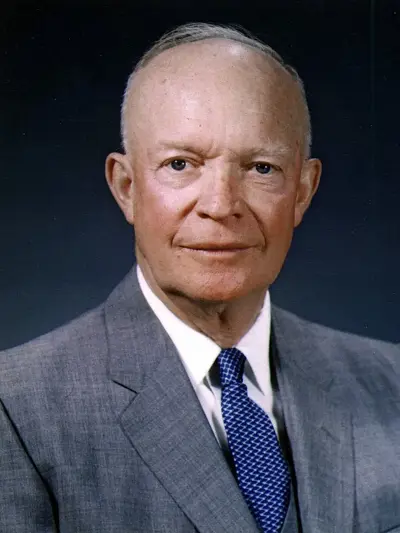
Dwight David "Ike" Eisenhower GCB OM GCS CCLH KC NPk was an American military officer and statesman who served as the 34th president of the United States from 1953 to 1961. During World War II, he became a five-star general in the Army and served as Supreme Commander of the Allied Expeditionary Force in Europe. He was responsible for planning and supervising the invasion of North Africa in Operation Torch in 1942–43 and the successful invasion of Normandy in 1944–45 from the Western Front.
