Elizabeth Cady Stanton Quotes
If the Bible teaches the equality of women, why does the church refuse to ordain women to preach the gospel, to fill the offices of deacons and elders, and to administer the Sacraments...?
Stanton, Elizabeth Cady. The Woman's Bible. European Publishing Company, 1895.


The secular government and the equal rights of women which transformed Turkey into a modern state under Ataturk had its roots with others in addition to Attaturk, Riza was the one who lead the parliament. Despite the Koran and Islamic tradition, polygamy was later abolished in Turkey—the first Islamic state to have done so since the founding of the religion.


The Bahai religion is one of the few whose doctrine is not sexist and advocates gender equality
This type of religious sexism is not unique to Islam. Fundamentalist Christians place women in a secondary role as do fundamentalist orthodox Jews although both allow a man to take only one wife. The Islamic scripture tells us that the Prophet allowed multiple wives only if the man had the resources to care for the wives and all the children. 4 is the maximum.

Since Pope Francis was so modern in so many areas there were hopes among some Roman Catholic reformers that the Pope would change the age old, discriminatry prohibition against women being priests.

The Bible and the Church have been the greatest stumbling blocks in the way of women’s emancipation.
The most important documents and doctrine of most churches were created by men who also established the framework of the religion. The result has in almost all cases been a sexist structure with women having not only little power not typically females are banned from all church governance. See {640303} for her quote on religion in general vis a vis women.
Almost all religions placed women in an inferior status in society with little of the freedom or power—civil or religious—for men that the religion urged.


She was responding to a minister who give the male Jesus argument. This quotation illustrates what a great debater and natural orator she was despite the lack of formal education.

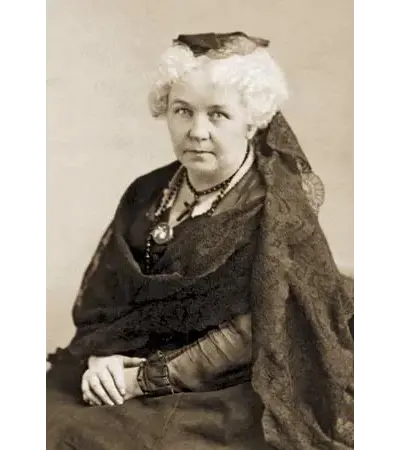
Elizabeth Cady Stanton was a leader of the women's rights movement in the U.S. during the mid- to late-1800s. She was the main force behind the 1848 Seneca Falls Convention, the first convention to be called for the sole purpose of discussing women's rights, and was the primary author of its Declaration of Sentiments. Her demand for women's right to vote generated a controversy at the convention but quickly became a central tenet of the women's movement. She was also active in other social reform activities, especially abolitionism.
