Vincent Bugliosi Quotes
If it's a close election, then it's better for the Supreme Court to pick the president, whether or not he won the election. It's just insane on its face.
Bugliosi, Vincent. The Betrayal of America: How the Supreme Court Undermined the Constitution and Chose Our President. Thunder's Mouth Press, 2001.


The Supreme Court divided 5-4 and all the Florida ballots were not counted.


Benton's solution was for the people to elect the President and Vice President directly.

Al Gore had substantially won the popular vote but needed Florida to win the electoral vote. There had been a series of vote counting irregularities with many people being denied the right to vote to the point that no one was sure who had won Florida. The election moved from the ballot box to the courts and the Florida Supreme Court ruled that there should be some recounts in areas where Bush had supposedly won. The Bush forces and the Republicans appealed to the Supreme Court where the judges all reversed their traditional positions to support the party who had nominated them. Liberals who usually voted to have the Federal government override the states, voted for Florida to be upheld. Conservatives who usually supported the right of the States to decide such things without Federal Interference, voted to overturn the State Supreme Court. There were 5 Republicans and 6 Democrats and George W. Bush won the election by one judge’s vote.

In the 2000 Presidential Election, Gore won the popular vote, but the electoral votes were so close that the winner depended on a single state, Florida. However, that state’s election process was poor and there were many irregularities and problems in vote counting and recounting. The Republican Secretary of State stated that the Republican candidate won, but the irregularities persuaded the Florida Supreme Court to order a recount. That decision was appealed to the Supreme Court which decided to stop the recount, giving the Presidency to Bush. All nine Supreme Court Justices were unhappy that they had to decide a case which determined who the President would be, but if they had refused to hear the case, the raw politics of Florida would determine the President. Stevens wrote this quotation in his dissent, and ironically it was about the only thing that the nine justices all agreed to—that the nation’s confidence in the Supreme Court and the legal system was the loser. There was no way for the court to win, unless they could have mustered an overwhelming majority for one side or the other. That proved impossible, so all the justices tried to make the best of a bad situation in which they had been placed.


Madison was right on most things, but got this one wrong. Of course he did not anticipate the era of mass communication which makes demagoguery in large areas possible.

This Pinkney view prevailed in the original Constitution, but this practice was reversed by the 17th Amendment of 1913. The source for this statement is the notes of Alexander Hamilton.


Donald Trump had won the presdiency by winning a majority of the votes of the Electoral College. However his opponent Hillary Clinton garnered about 2 million more votes. Several other presidents have won with a minority vote. These occurances did not affect the Presidents' legitimacy as the Electoral College was specified in the Constitution, However, it did undercut the concept that the President had a mandate. Other presidents just carried on and either earded the respect of the majoprity of AMericans or did not over time. Howevewr, Trump, who was so sensitive and fragile about his image, kept responding to comedians like Bee by claiming that the only reason he lost the poular vote was voter fraud by illegal immigrants. However he never offered any evidence of such and there were no convictions for same or even arrests and trials.
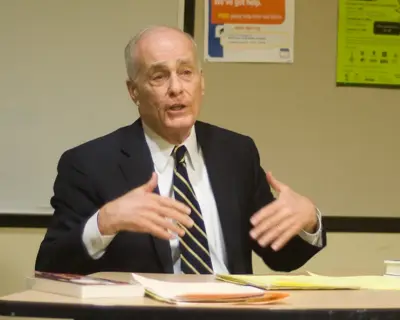
Vincent T. Bugliosi Jr. was an American attorney and New York Times bestselling author. During his eight years in the Los Angeles County District Attorney's Office, he successfully prosecuted 105 out of 106 felony jury trials, which included 21 murder convictions. He was best known for prosecuting Charles Manson and other defendants accused of the Tate–LaBianca murders of August 9–10, 1969.
