Narendra Modi Quotes
If I talk about coal, people will start equating my statements with a political angle. This is not a platform for politics, I'm not making any allegations on anyone.
Modi, Narendra. "PM's interaction with School Children on the occasion of Teachers' Day." Prime Minister's Office, Government of India, 5 Sept. 2014, pib.gov.in/newsite/PrintRelease.aspx?relid=109395.


At the time this article was written coal was being phased out in most of the country but not as the result of any political actions. The new technologies of producing shale oil and fracking had driven down the price of natural gas and oil, making coal the most expensive fuel alternative so the market place was finally doing what the politicians would not do. Ironically, the conservative politicians from coal producing states like West Virginia and Kentucky, who would normally say that government should always defer to the marketplace, then called for government action to protect the coal industry from the marketplace.


This quotation became a slogan of the miners. Lewis did not originate it. It has been referred to as early as 1902 in the bitter coal strike of that year. Generally coal mining strikes have involved more force and military than most labor disputes. While labor representatives maintain that force does not help, mine owners have believed that force is absolutely necessary. See Richard B. Mellon’s testimony to Congress in 1937--{563576}.

See {635006} for a slightly earlier French solar engine. Much of the most effective uses of Solar power uses the concentrated heat of the sun to heat water or some other substance like this device. The vast majority of the hot water heaters in Israel function on this principle—no electricity or any other fossil fuel. The only reason that the solar engines of the time were more costly where fuel was available is that no one realized the huge environmental consequence of the fossil fuels. Today we do realize that but do not charge the oil and gas companies and consumers to cover the costs of fixing what we know about and are able to remedy. Solar powered equipment is not a modern invention however and has been with us for well over a century. Paul Collins wrote “He calculated that solar power cost about ten times as much as coal, so that until coal began to run out, solar power would not be economically feasible. But this, to him, was not a sign of failure—there was no question that fossil fuels would indeed run out someday. The great engineer maintained an unshakeable belief in the future of solar power to his last breath; he had set up a large engine in his backyard and was still perfecting it when he collapsed in early 1889. Though his doctor made him rest, Ericsson could not sleep at night: he complained that he could not stop thinking about his work yet to be done.” The only reason that the solar engines of the time were more costly where fuel was available is that no one realized the huge environmental consequence of the fossil fuels. Today we do realize that, but do not charge the oil and gas companies and therefore consumers cover the costs of fixing what we know about and are able to remedy. Solar powered equipment is not a modern invention however and has been with us for well over a century.

This quotation on the surface appears to be a clear summary of the scientifically measured negative aspects to coal. However, it was an extremely bitter political quotation. The reason was that West Virginia and the other parts of Appalachia depend on coal for employment—jobs for the residents in a poverty-stricken area where there are few other potential sources for employment. Coal is also a key economic component of the economy in Wyoming. These states regard the reduction of coal as an energy source as one of the most serious political threats to their states and the treat it accordingly. West Virginia has Democratic Senators and congressmen from Appalachia. Wyoming has Republicans. Both exert enormous pressure on their Congressional Party leadership and the White House. With the country and Congress split at the time, Republicans had control of the House, and Democrats, the Senate and the Presidency—by very narrow margins so the leaderships cannot offend anyone in Congress. The result is that there was almost total silence about the huge coal pollution problem, and even in the second decade of the 21st century, where shale natural Gas was extractable in sufficient quantities to totally replace Coal as a fuel source, few in Congress or the administration ever even spoke of adopting a national policy to this effect, much less passed any legislation. During this period many Americans sickened and died as a result of coal every year with no end in sight.


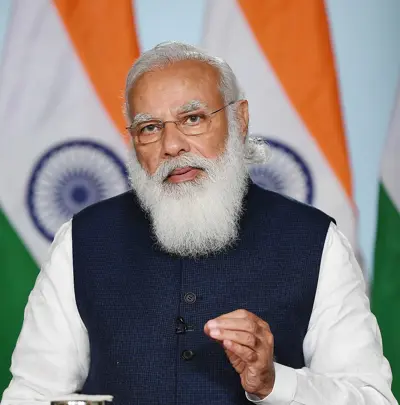
Narendra Damodardas Modi is an Indian politician serving as the 14th and current Prime Minister of India since 2014. He was the Chief Minister of Gujarat from 2001 to 2014 and is the Member of Parliament for Varanasi. Modi is a member of the Bharatiya Janata Party (BJP) and its National Democratic Alliance (NDA). He is also a member of the Rashtriya Swayamsevak Sangh (RSS), a Hindu nationalist volunteer organisation. He is the first prime minister born after India's independence, the second non-Congress one to win two consecutive terms after Atal Bihari Vajpayee and the first from outside the Congress to win both terms with a majority in the Lok Sabha.
