Thomas P.M. Barnett Quotes
If America is addicted to foreign money and foreign oil, then China is addicted to foreign supplies of just about every commodity known to man - save highly polluting coal.
Barnett, Thomas P.M. Great Powers: America and the World After Bush. G.P. Putnam's Sons, 2009.

With the largest population in the world and the rapid growth in the standard of living, China had replaced the United States and Europe as the most desirable export target.


He was opposing the view of President Donald Trump that the United States needs trade protectionism in order to preserve and grow manufacturing jobs. Flake and the majority of the Contgress maintained that protectionism at best would lose more jobs and growth possiblities than it would save, and at worst could start a trade war that throws teh United States into a recession or even a depression.

It is very easy for an American company to make parts in the United States, ship them to Mexico for assembly and bring the finished product back. However, for counties like France it is much more difficult.


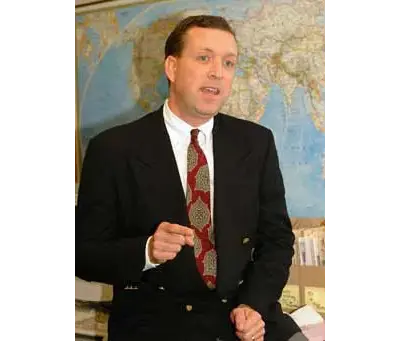
Thomas P.M. Barnett (born 1962) is an American military geostrategist and former chief analyst at Wikistrat. He developed a geopolitical theory that divided the world into "the Functioning Core" and the "Non-Integrating Gap" that made him particularly notable prior to the 2003 U.S. Invasion of Iraq when he wrote an article for Esquire in support of the military action entitled "The Pentagon's New Map" (which would later become the title of a book that would elaborate on his geopolitical theories). The central thesis of his geopolitical theory is that the connections the globalization brings between countries (including network connectivity, financial transactions, and media flows) are synonymous with those countries with stable governments, rising standards of living, and "more deaths by suicide than by murder". These countries form the Functioning Core. These regions contrast with those where globalization has not yet penetrated, which is synonymous with political repression, poverty, disease, and mass-murder, and conflict. These areas make up the Non-Integrating Gap.
