Cut Nose Quotes
I would be glad if the whites would pick out a place for themselves and not come into our grounds.
Cut Nose, ?, Arapaho Indian Chief, Statement, Horse Creek Council, Wyoming, 1851
Sourced by: Eigen's Political and Historical Quotations


This law is meant to curb the The meetings were parties and other forms of recreation.


Booth was the younger son of a very prominent Northern family of actors. His older brother was considered the greatest American actor, and the rest of the family were abolitionists and vehement Union supporters. They found young John’s views reprehensible.

The highway was planned to go through a poor neighborhood which had a high percentage of Black residents—all of whom would have to find other housing and move to make room for the highway. If the government plans a highway through a wealthy area, the cost to condemn and pay for the land will be much greater than if a poor neighborhood is acquired. For urban highways, the poor almost always bear a disproportionate share of the inconvenience while the major benefit inures to the wealthy and middle class. Abbot had been a labor organizer and a professional artist before he entered politics. The graphic is of his famous poster which by itself stopped the plans to build the highway very quickly.
The Iroquois were among the most sophisticated of the North American Indian Tribes. They also were highly assimilated into the American society. In the next decades, they would switch their political position when New York State provided better legal guarantees for Iroquois land than the Federal Government. By the end of the 20th Century, led by the Iroquois, the Indian residents of New York State had the same level of earnings as the white man—and that was with NO INDIAN GAMING.

Carson was one of the few Indian Agents who spent every penny of his budget on the Indians as opposed to himself. He was married to an Indian woman and was close enough to many Indians that he understood their resentment whenever they came into a town. They were treated terribly and while most of them were literally starving, seeing the white opulence produced resentment.

Smith, an extreme racist, was so rabid that MacGregor was supporting the Civil Rights Bill, he followed him off the House floor to make this statement. MacGregor jokingly told Smith that he was wrong. He had 17 Negroes in his District.


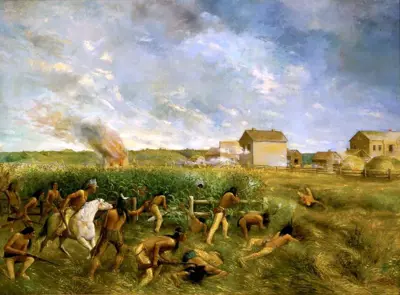
The Dakota War of 1862, also known as the Sioux Uprising, the Dakota Uprising, the Sioux Outbreak of 1862, the Dakota Conflict, the US-Dakota War of 1862, or Little Crow's War, was an armed conflict between the United States and several bands of Dakota (also known as the eastern Sioux). It began on August 17, 1862, along the Minnesota River in southwest Minnesota, four years after its admission as a state. Throughout the late 1850s in the lead-up to the war, late annuity payments by Indian agents caused increasing hunger and hardship among the Dakota. During the war, the Dakota made extensive attacks on hundreds of settlers and immigrants, which resulted in settler deaths, and caused many to flee the area. This ended with soldiers capturing hundreds of Dakota men and interning their families. A military tribunal quickly tried the men, sentencing 303 to death for their crimes. President Abraham Lincoln would later commute the sentence of 264 of them. The mass hanging of 38 Dakota men was conducted on December 26, 1862, in Mankato, Minnesota; it was the largest mass execution in United States history.
