Bartolomeo Vanzetti Quotes
I wish to say to you that I am innocent. I have never done a crime, some sins, but never any crime. I thank you for everything you have done for me. I am innocent of all crime, not only this one, but of all, all. I am an innocent man. I now wish to forgive some people for what they are doing to me.
In 1920 in the midst of a wave of anarchist bombings, two men in Braintree, MA were murdered in an armed robbery. Vanzetti and another political anarchist, Ferdinando Nicola Sacco, were charged with the crime. While anarchy was a non-violent philosophy for many, there was another movement imported from Europe who used bombings as a method of terror and protest to achieve their political aims. Vanzetti and Sacco were of the former type with no criminal record whatsoever but both were considered politically undesirable and part of the terrorist anarchist movement that had been striking in a number of cities. Most Americans saw little difference between the anarchists and the communists although there were foes. These anarchist men were tried, convicted, and sentenced to death for the robbery and murders despite what was very flimsy and contradictory evidence. In Vanzetti’s case, the evidence against him was the fact that 2 of the shell casings from the crime scene were according to the police fired from the same type of Colt pistol that Vanzetti owned. However, 300,000 other people owned the same type of gun, and ballistics scientific evidence later showed that the shells could not have been fired from Vanzetti’s gun. The case became a worldwide cause celebre with politics, police and judicial misconduct. Even today, there is no clear evidence of either their guilt of innocence (although there was even less evidence against Vanzetti), However, the trial brought more publicity to the anarchist political philosophy than the defendants could have imagined. It also called the finality of capital punishment into question and caused major examination of the police, prosecutorial, judicial systems and even the defense attorneys. The two men were electrocuted on August 23, 1927 amid protests the world over. See {625975} and {600317} for example.
Bartolomeo Vanzetti, 1888–1927, Protester & Anarchist, Last Words
Sourced by: Eigen's Political and Historical Quotations

In 1920 in the midst of a wave of anarchist bombings, two men in Braintree, MA were murdered in an armed robbery. Vanzetti and another political anarchist, Ferdinando Nicola Sacco, were charged with the crime. While anarchy was a non-violent philosophy for many, there was another movement imported from Europe who used bombings as a method of terror and protest to achieve their political aims. Vanzetti and Sacco were of the former type with no criminal record whatsoever but both were considered politically undesirable and part of the terrorist anarchist movement that had been striking in a number of cities. These men were tried, convicted, and sentenced to death for the robbery and murders despite what was very flimsy and contradictory evidence. In Vanzetti’s case, the evidence against him was the fact that 2 of the shell casings from the crime scene were according to the police fired from the same type of Colt pistol that Vanzetti owned. However, 300,000 other people owned the same type of gun, and ballistics scientific evidence later showed that the shells could not have been fired from Vanzetti’s gun. The case became a worldwide cause celebre with politics, police and judicial misconduct. Even today, there is no clear evidence of either their guilt of innocence (although there was even less evidence against Vanzetti), However, the trial brought more publicity to the anarchist political philosophy than the defendants could have imagined. It also called the finality of capital punishment into question and caused major examination of the police, prosecutorial, judicial systems and even the defense attorneys. The two men were electrocuted on August 23, 1927 amid protests the world over.


Unfortunately, his close successors did not share Alexander’s surprisingly modern view.


1st Baron Macaulay


There was quite a bit of racism in the American West. Not the last sentence referring to the complexion of the defendant.


Texas executes more people than the rest of the United States does. However, just before the debate an investigation disclosed 56 recent cases in Texas where the “criminals” were completely exonerated based on the work of some volunteer attorneys and law students. They were all released from jail where many had served decades for crimes they did not commit. 5 were released from Death Row—awaiting to be executed. See {635339}.

This interesting historical quotation illustrates the fact that in almost every American generation there are those who believe that society has gone too far in protecting the rights of criminal suspects at the expense of law and order in the general society. This is nothing new. This is a classic argument given by those who would deny a defendant the Constitutional protection against self-incrimination. The belief that an innocent man has nothing to fear from the police is refuted by the many cases of innocent men being convicted by evidence they have given in the belief that they were innocent, and served long jail sentences only to later be proved by DNA evidence that they could not possibly have been guilty. Since Nott’s day, society has not only found many cases where honest error was made by the police or prosecutors, but many where there was venal prosecutorial misconduct and defendants were jailed even though the authorities were aware of evidence of innocence and kept it secret. There have been a number of these cases where a defendant was on death row and about to be executed when it was found he was innocent. Probably there have been men wrongly executed. See {629444} for a probable example.


This is the first appearance of the principle which guides law enforcement in most of America and the other industrialized democracies around the world. Texas and some other localities have rejected this notion and see the occasional execution of an innocent person the cost we must pay in order to preserve law and order.


The admiral, who was the intellectual leader of the junta during the “Dirty War,” confessed to the facts but claimed that the drastic steps were appropriate and necessary. Further, that there was no “guilt” involved in an act of executive necessity. The court did not agree and he was convicted, but was later pardoned along with the other war criminals by President Carlos Menem.


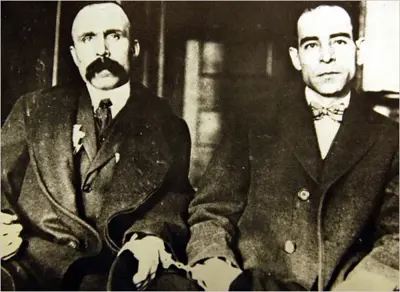
- Born: April 22, 1891
- Died: August 23, 1927
- Nationality:
- Profession:
Nicola Sacco and Bartolomeo Vanzetti (pronounced [bartoloˈmɛːo vanˈtsetti, -ˈdzet-]; June 11, 1888 – August 23, 1927) were Italian immigrant anarchists who were controversially convicted of murdering a guard and a paymaster during the April 15, 1920, armed robbery of the Slater and Morrill Shoe Company in Braintree, Massachusetts, United States. Seven years later, they were electrocuted in the electric chair at Charlestown State Prison.
