John C. Calhoun Quotes
I will never consent to make our penal code the basis of our Ways and Means …
John C. Calhoun, 1782-1850, Vice President of the United States (Democrat, SC), U. S. Congressman & Senator (Democrat, SC), Congressional debate, 1812
Sourced by: Eigen's Political and Historical Quotations


Although the Professor was often right about this technique, at the time he made this statement, the Clinton administration was actually cutting spending and using much of the revenue to pay for the deficit—just the opposite of what the Professor was worried about. It was successful and the deficit was eliminated and surpluses were projected. However the succeeding administration more closely followed the professor’s pattern and increased spending enormously for serious needs, but also cut taxes, so that we went during the Bush administration from the largest projected surplus in American history to the greatest deficit in American history.


After the Stock Market crash of 1929, Republican politicians promised "recovery is right around the corner." But La Guardia disagreed:


In 1992 Colorado passed a Taxpayer's Bill of Rights, known as TABOR that requires that spending increases get voter approval and the state refunds surpluses through a series of tax cuts. So the state ended up with the problem that Zelinski described.

An unusual feature of the American governmental budgeting process is that Congress has passed a law limiting the amount of debt that the United States can maintain. When there is deficit financing, the law limiting the debt has to be changed periodically as the nation approaches the debt limit. Partisan politicians often take advantage of the fact that the debt limit must be passed and hold the passage hostage to obtaining something they want. The reality is that when Congress passed the previous budgets, they determined what the debt would have to be later. So they have already voted to exceed the budget ceiling. But the requirement of doing it in a second forum allows more pressure to be placed on the administration and the other party’s Congress members. While this process is ongoing, many people in the world are worried and often terrorized by the prospect of the debt ceiling not being passed, in which case the United States would have to default on its obligations—not pay interest, contractors, retirements, salaries, etc. Hence the admonition that the debt ceiling should never be a part of the budget negotiating process by most responsible statesmen and women. But the mist partisan of the politicians want to play politics with the debt ceiling precisely because the stakes are so high and they can get both headlines and leverage.


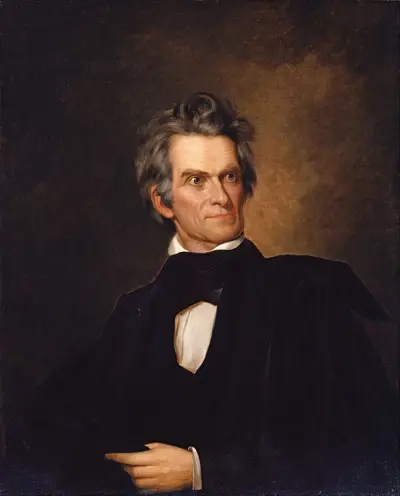
John Caldwell Calhoun was an American politician and political theorist from South Carolina who held many important positions including being the seventh vice president of the United States from 1825 to 1832, while adamantly defending slavery and protecting the interests of the white South when its residents were outnumbered by Northerners. He began his political career as a nationalist, modernizer, and proponent of a strong national government and protective tariffs. In the late 1820s, his views changed radically, and he became a leading proponent of states' rights, limited government, nullification, and opposition to high tariffs. He saw Northern acceptance of those policies as a condition of the South remaining in the Union. His beliefs and warnings heavily influenced the South's secession from the Union in 1860–1861.
