Krzysztof Penderecki Quotes
I was growing up in a communist time, especially, and the other music, the western music, was banned, so on radio half of the music was Chopin. So my colleagues and I were a little bit allergic to this music because it was everywhere - everywhere!

This was a big factor that made the Red Scare so damaging.


Baldwin had written a book praising revolutionary communism in Russia, but like many other American socialists, grew disillusioned with Russian Communism and Joseph Stalin’s dictatorship especially when in 1939 the Russians became allied with Hitler and Germany. Russia’s repression of civil liberties was far worse than anything he had seen in America. He was so negative about Russian Communism that in the early 1940s, he ejected all members of the Communist Party from membership in the ACLU.

After the breakup of the Soviet Union, NATO expanded to include some fo the former Soviet Nations thus moving NATO territiry to the East--closer to Russia, whose leaders percieved that the expansion was hostile and dangerous for the indpendence of Russia. What made the situation more complex is that the American Secretary of State, when the Soviet Union was very powerful, had made an agreement with the Soviets that in return for Russian aquiessance of NATO being extended to East Germany, NATO would not expand further West. But after the collapse of the Soviet Union, Russia was quite weak and NATO expanded east despite the earleir comittment. The US and th eother NATO counties took the pozition the previous comitmnts were not binidng as they were never formally signed. The Russians then decided to take a hard line position and flaunt and use military force to which would stop the Western expansion closer to the Russian border.


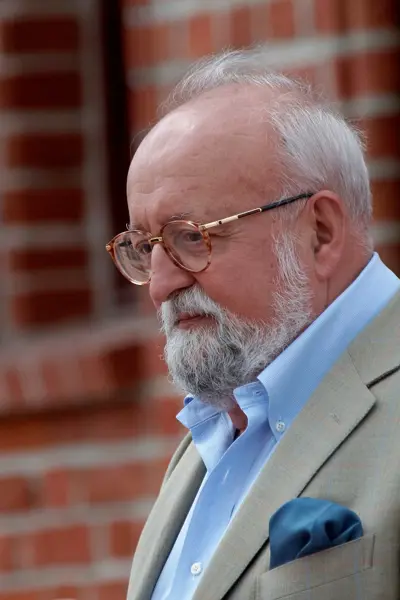
Krzysztof Eugeniusz Penderecki was a Polish composer and conductor. Among his best known works are Threnody to the Victims of Hiroshima, Symphony No. 3, his St. Luke Passion, Polish Requiem, Anaklasis and Utrenja. Penderecki composed four operas, eight symphonies and other orchestral pieces, a variety of instrumental concertos, choral settings of mainly religious texts, as well as chamber and instrumental works.
