Nelson Mandela Quotes
I was first imprisoned in Pretoria, and then, thereafter, I was taken to Robben Island. I stayed there for a couple of weeks. I was taken back to Pretoria when I was charged in the Rivonia trial, when I was then sent to Robben Island for life.
Mandela, Nelson. Interview by Larry King. Larry King Live, CNN, 16 May 2000.


After the assassination of Egyptian President Anwar Sadat hundreds of Egyptian religious fundamentalists were rounded up, jailed and tortured. al-Zawahiri broke under torture and revealed the names of some of his anti-government associates. Although he was not personally involved in the murder of Sadat, he served three additional years in jail. Motivated by has thirst for revenge at his torturers and his guilt at having been forced to betray his friend, he learned all he could about terrorism from the older Jihadists also in the same jail, and when he was released he elevated Islamic terrorism to another level by developing a strategy for the use of suicide bombers.


It is unfortunately too common that people have been convicted and jailed because of misconduct of the police or prosecutors. Most criminal justice agencies in recent years have examined their methods and procedures and reforms are in progress. But there is still a human problem. For an example see Quote
Named after penal reformer Johne Howard, 1726-1790. Howard Associations have since been organized in many countries.

Leary was a strong advocate of the use of illicit drugs and stimulants. Yet he ignored all the side effects and negative health consequences of the processes and while he thought he was assisting people to enlarge their mental horizons, he irresponsibly and criminally damaged many permanently. His government “persecutors” themselves were also all disgraced by the extremes to which they went to prevent the counter-culture characterized by Leary and others. They became paramoid that the drug culture would morph into a protest culture against the administration. The tended to exxagerate the negative consequences of illicit drugs--especially marijuana. These exaggerations caused many people to believe Leary and others who went to the other extreme and underated the negative consequences of illicit drugs. It became a culture war when it should have been a medical problem.

It was never submitted as evidence in any proceeding or made a part of the U. S. investigatory record of war crimes of World War II. Nor was it ever found in Japan in the official records. The only copy was found in 2003 at the home of Bonner F. Fellers one of MacArthur’s top aids in the Japanese Occupation. Fellers and McArthur advocated not further investigating or trying the Japanese Emperor either because they, believed he was not guilty or because they thought his trial would be too disruptive to the occupation. The authenticity of this monologue has not been verified. Apologists for the Emperor argue that it shows that he was a virtual prisoner of the militarists and unable to stop the war or any of the war crimes; others argue that the Japanese military would never have gone against the will of the Emperor and that this document was probably prepared with the coaching of General Fellers as ex post facto “evidence” of the Emperor’s innocence. See {643148} and {601309} for examples of Fellers manipulating the “evidence.”


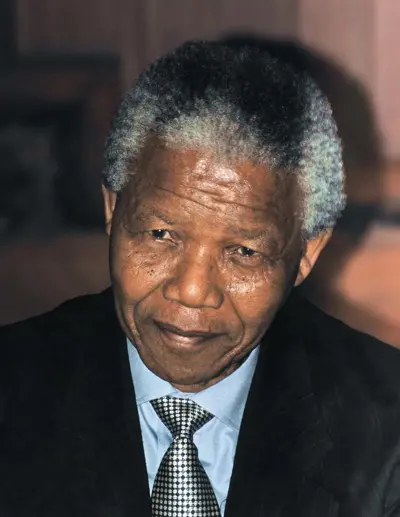
Nelson Rolihlahla Mandela was a South African anti-apartheid revolutionary, political leader and philanthropist who served as President of South Africa from 1994 to 1999. He was the country's first black head of state and the first elected in a fully representative democratic election. His government focused on dismantling the legacy of apartheid by tackling institutionalised racism and fostering racial reconciliation. Ideologically an African nationalist and socialist, he served as the president of the African National Congress (ANC) party from 1991 to 1997.
