Tom Brokaw Quotes
I was a young man working in Omaha, Nebraska, in the mid-1960s when I received a call, and I was summoned to Atlanta to work at WSB. It was, for me, the beginning of a real education about the South.
Brokaw, Tom. A Long Way from Home: Growing Up in the American Heartland. Random House, 2002.


It was used as a whipping boy and led to a re-alignment of Southern politicians to the Republican party.

This quotation shows two important historical facts about Southern Racism. The first is now great the social pressures were against any white who would try and alter the status quo. The second was that none the less there have always been whites in the South who, despite the great social penalties, did the right thing and not only improved the situation, but more important, made most Americans realize that Southerners were not all racists any more than all of any group had any negative behavior.


This was art of the Nixon "Southern Strategy" to alienate the white supremacists and racists from the Democratic Party with Civil Rights legislation and rhetoric, and get most of them to become Republicans. But as Phillips observed, when Negroes began voting in significant numbers in the South the party switching really accelerated.


The statement was made even more dramatic as the outgoing Governor, Lester Mattox, standing behind Carter at the ceremony, was an arch segregationist.

Historically, the Southern reaction to early 20th centry Civil Rights efforts was that it was the work of communist and anarchist radicals who were trying to destabilize America. When that argument began to be exposed as false, the next line of defense was that the southern Negro was perfectly happy in the segregated South, and the only problem was Northern liberals, black and white, who came to the South to foment trouble.


Arkansas Governor Faubus ordered the national guard to prevent Black students from integrating Central High School in Little Rock. President Eisenhower was a man of action and not rhetoric and his lack of firm public statements overlooked an opportunity to use the Presidential “bully pulpit” and exercise his moral leadership and authority. Armstrong was irate at Eisenhower for appearing to do nothing and say nothing. See {615852}. When Eisenhower did enforce the court order and used Federal troops, Armstrong sent him this congratulatory telegram. His reference to walking into the schools was in support of many who suggested that the best thing the President could have done was to personally take one of the Black students by the hand and walk into the school with him or her. With the mood of the Southern racists, such an act was potentially very risky for the President and it is not known whether of not the President and his staff ever considered such an act.


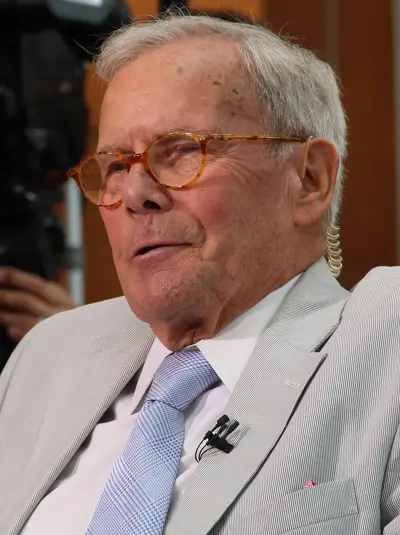
Thomas John Brokaw is an American retired television journalist and author. He first served as the co-anchor of The Today Show from 1976 to 1981 with Jane Pauley, then as the anchor and managing editor of NBC Nightly News for 22 years (1982–2004). He was also a weekend anchor for the program from before from 1973 to 1976. He is the only person to have hosted all three major NBC News programs: The Today Show, NBC Nightly News, and, briefly, Meet the Press. He formerly serves as a special correspondent for NBC News and works on documentaries for other outlets.
