Muhammad Yunus Quotes
I wanted to make sure that women made up half of all Grameen's borrowers. But it wasn't easy to persuade the women in Bangladesh to join the bank. A man isn't even allowed to address a woman in her village.
Muhammad Yunus, Bangladeshi Economist, Founder, Grameen Bank, The Markkula Center for Applied Ethics, Reflections on Working Toward Peace
Sourced by: Eigen's Political and Historical Quotations


Prevented by the Military from ever taking office

She was the First Lady, who in many ways was also one of the nation’s leading feminists. Betty Ford, Barbara Bush, and Hillary Clinton were also First Ladies who supported key feminist position but ER was 30 years ahead of them—a time when conservatives and sexists viewed her as a dangerous radical. For example, see {585211}.

She was also Australia’s First Woman Cabinet Minister.

Although this was written in a 1920 letter, the letter was not publicly published until 1970.


Actually, shortly thereafter some women in Egypt were allowed to be judges, but were not allowed to handle serious criminal cases on the grounds that women could not be hard enough to impose heavy punishment like the death penalty.


She had been instrumental in changing the laws so that in most things women had equal rights, but they had not voted before, and did not read much about politics, and were not used to behaving as someone who had equal rights vis a vis anyone else.
Mrs. Roosevelt thought that with the rate of improvement in society’s perception and treatment of women was improving so steadily that women in America were not far from equality. Because of the shortage of men on the home front in WWII women had performed well in virtually all occupations including welding, heavy construction and management and it was just a matter of time to reach equality of pay and parity. However, she and most feminists did not take into account the 2 million men returning from military service who wanted their jobs back. Sexists, who had been suppressed during the war when they objected to women in non traditional occupations, were no longer silenced by national necessity. An occupational backlash developed. Then a sexual one regarding contraception and family planning, (Condoms for example were illegal up to 1963 as birth control device). Each major step forward was accompanied by its own backlash and even in the Presidential Campaign of 2012 contained debate on women’s control over their own bodies relative to abortion and contraception.

During the Civil War, the government produced paper money for the first time. The clerks in the Treasury had to cut the printed money to size and separate the several bills on a sheet. However, with more work and men needed for the war effort, Spinner came up with the good idea of using women as Treasury Department Clerks. Chase, one of Lincoln’s rivals for the Presidency, was the Secretary of the Treasury and although not enthused allowed Spinner to allow some women into the Federal Workforce. See {629786} for one reaction.


Jinnah was a modern Islamic reformer as this quotation demonstrates. Pakistan is not as backward as most of the Arab Islamic countries on the role of women. There are many Pakistani businesswomen and professionals. Pakistan has even had a female president. However, the fundamentalist Islamic forces that dominate the culture constantly preach and advocate the literal interpretation and following of Sharia which calls for a traditional, subservient traditional role for women; “honor killings” are common; “a rapist cannot be convicted on a female victims testimony; there are calls for the killing of adulteresses and other primitive throwbacks. Jinnah’s vision has not come to pass yet.

The Act allowed women and other workers who were the victims of wage discrimination to sue the discriminating employers even after the statute of limitations and run out provided that they victim had no knowledge of the discrimination. Lilly Ledbetter was a Goodyear Supervisor who was for years paid far less than the male supervisors doing the same work. But the company kept it secret and Ms. Ledbetter didn’t find out until the statute of limitations had said she could no longer sue. The Lilly Ledbetter Act corrected that injustice. President Obama observed that discrimination in pay affects not only the woman or other worker, but also the entire family which might therefor not be able to obtain health care, education, or care for elderly parents. At the time that this quotation was made, white women in America who were working full time were earning only 77 percent of what men earned. For minority women, the proportion is even less. As bad as that was, it was an improvement over the situation when the equal pay act was passed 50 years before. Then, women earned only 53 percent of what a man did.

Given the time, this was an amazing demand. Fuller preceded all the more famous American feminists and was an inspiration to them.
Marcus Porcius Cato. This quotation has had two different interpretations over time. One was that women if they received equality of treatment and voting would have an advantage for they also had their traditional “feminine wiles” and their sexuality, hence would dominate men. The second was a also a warning but based on the fact that women were superior in many ways, and given an equal chance, would excel men. The later interpretation is argued by some who point to the 2011 American data that shows more females than males graduating from high school and college, and females outnumber males in medical, law and several other professional schools. With the exception of a few Roman men, most heeded Cato’s warning and never took a chance on female equality.

The speaking to which she was referring was Christian Religious preaching by women. At the time it was considered by most Christians to be sacrilegious for women to preach. This came down from the orthodox Jewish tradition, and there are several passages in the New Testament where the Apostles, who were Jews themselves were echoing the religious tradition. This then took on a meaning that went beyond tradition as in Judaism. Margaret Fox wrote this essay which was a completely theological defense of a woman’s right – indeed obligation—to preach. Theologically, there are many Christian churches for whom her argument would be too radical—even in modern times. However, in the middle of the 17th century to most male clerics, this was so unfathomable that they did not even deign to refute her theological arguments. Meanwhile, the Quakers began to accept women in theological positions of influence—for ahead of most other Christian and Jewish sects. See {619836} and {619837} for quotations from the essay itself.

See {618590} for an example of the kinds of issues which motivated her statement.
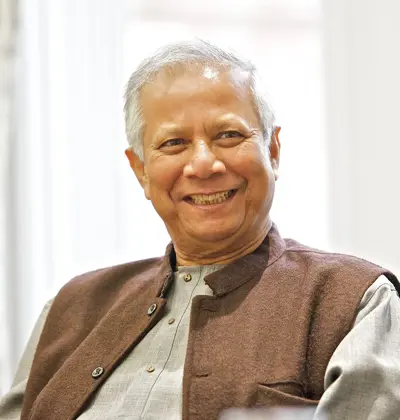
Muhammad Yunus is a Bangladeshi social entrepreneur, banker, economist, and civil society leader who was awarded the Nobel Peace Prize for founding the Grameen Bank and pioneering the concepts of microcredit and microfinance. These loans are given to entrepreneurs too poor to qualify for traditional bank loans. Yunus and the Grameen Bank were jointly awarded the Nobel Peace Prize "for their efforts through microcredit to create economic and social development from below". The Norwegian Nobel Committee said that "lasting peace cannot be achieved unless large population groups find ways in which to break out of poverty" and that "across cultures and civilizations, Yunus and Grameen Bank have shown that even the poorest of the poor can work to bring about their own development". Yunus has received several other national and international honours. He received the United States Presidential Medal of Freedom in 2009 and the Congressional Gold Medal in 2010.
