Elvira Nabiullina Quotes
I think that many central banks and financial authorities understand that any long term attempt to compete through an artificial depreciation of their currency will not be very effective in the long term.
Nabiullina, Elvira. "CNBC Transcript: Elvira Nabiullina, Governor, Bank of Russia." Interview by Geoff Cutmore. CNBC, 21 June 2013.


Currency Pegs are policies and commitments that countries make to sate that their currency henceforth will have a fixed relationship to another currency—usually the American Dollar, the English Pound or the Euro. If a second and even more countries also agree to peg their currency to the same, then the counties who are pegging can trust each other’s currency providing economic stability and facilitating trade.


“Pegged” exchange rates are a country’s money where the Government sets the value of the money in terms of some other currency—usually American dollars. The advantage of a pegged currency is that it is stable and does not fluctuate day to day. The disadvantage is that people realize that the value is artificial and other countries will not accept the pegged currency. Worse natives try and get as many dollars as they can because the fear that the Government will devalue and change the rate of exchange of the pegged currency.


What the Prime Minister was trying to say is that the buying power had not been diminished suddenly for local and non-imported items.


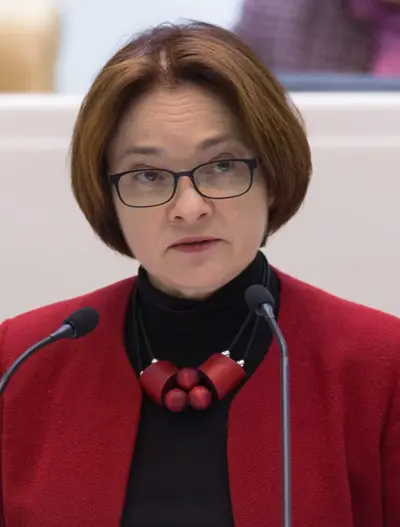
Elvira Sakhipzadovna Nabiullina is a Russian economist and head of the Central Bank of Russia. She was Russian President Vladimir Putin's economic adviser between May 2012 to June 2013 after serving as minister of economic development and trade from September 2007 to May 2012. As of 2019, she is listed as the 53rd most powerful woman in the world by Forbes.
