Vincent Bugliosi Quotes
I think I present an overwhelming case that these five justices were up to no good, and they deliberately set out to hand the election to George Bush.
Bugliosi, Vincent. The Betrayal of America: How the Supreme Court Undermined the Constitution and Chose Our President. Thunder's Mouth Press, 2001.


In the razor thin 2000 Presidential election the Republican controlled Florida legislator called a special session to name their own electors to go to the electoral college. The Governor, Jeb Bush, was the brother of the Republican candidate.


George W. Bush and the Republicans The President surprised even his supporters by publicly referring to the taint on the George W. Bush election where a 5-4 Supreme Court decision prevented the hand counting of Florida ballots after Bush had already lost the popular vote and was in danger of losing the electoral vote as well.


Chase a Supreme Court justice at the time was a very partisan Federalist. The Senate was controlled by the Democratic Republicans. Randolph, then a member of the House of Representatives, orchestrated the impeachment of Chase because of his extreme partisanship. The Senate in trying the case had to decide for the first time what “high crimes and misdemeanors” the actually means in terms of impeachment. A number of the Democratic Republicans joined the Federalists in taking the view that however undesirable the Supreme Court justice’s partisanship would be, that did not reach the threshold of a “high crime and misdemeanor.” Chase was acquitted. In this sense this impeachment trial was similar to that of President William Clinton almost 200 years later. The behavior was undesirable but did not amount to a high crime and misdemeanor, Clinton was also acquitted.

In 1911 the Supreme Court upheld the monopoly conviction of Standard Oil Company but held that the Sherman Antitrust Act only applied to “unreasonable” monopolies and not to monopolies in general.

The Roosevelt administration had stemmed the tide of Hoover’s Great Depression but the nation had not yet recovered. The New Deal measures, most of which would be considered fundamental to good government 50 years later was being constantly thwarted by a Supreme Court with a strong arch conservative majority headed by James McReynolds, a virulent, overt, anti-Semitic racist, who hated FDR—see {616652} and {585241}. The situation was to many like that which existed before the Civil War when the Court rendered the Dred Scott decision that so harmed the nation. Frankfurter, not then a Supreme Court Justice, urged Roosevelt to do something lest the American Public lose all respect for the Court and our Constitutional system and have the nation harmed by not allowing reforms like child labor laws to go through. The court actually ruled by a narrow majority that the government could not pass laws making it illegal for 11 year old children to work in coal mines or factories. FDR attempted to add more justices turning the majority into a majority—“packing the Supreme Court”, but that politically backfired. Some of the reforms never went through while others needed Constitutional Amendments like the end to Prohibition.

Then Clarence Thomas replaced Thurgood Marshall on the Supreme Court, there appeared to be a majority of the court that would overturn Roe v. Wade and a woman’s right to an abortion. However it was an election year and the Chief Justice, a Republican, was concerned that if Roe was overturned the electorate might take it out on the Republicans, whose Solicitor Generals had fought to overturn Roe, at the polls. He therefore postponed the hearing of a Pennsylvania case, and then tried to postpone it again till after the election. Blackmun’s memo caused a majority of the court to vote to hear the case with no additional delay. Ironically, by a single vote, Roe was upheld.


This kind of attack on the Supreme Court by a prominent legal figure is quite unusual. However, the appointment of the ideologue, Clarence Thomas and his effect on the balance of the court triggered much controversy.

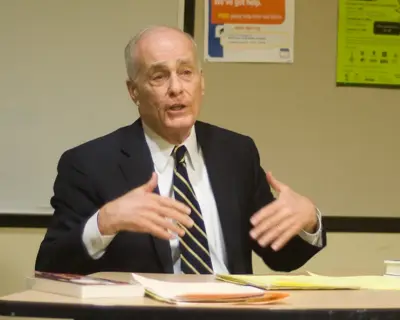
Vincent T. Bugliosi Jr. was an American attorney and New York Times bestselling author. During his eight years in the Los Angeles County District Attorney's Office, he successfully prosecuted 105 out of 106 felony jury trials, which included 21 murder convictions. He was best known for prosecuting Charles Manson and other defendants accused of the Tate–LaBianca murders of August 9–10, 1969.
